
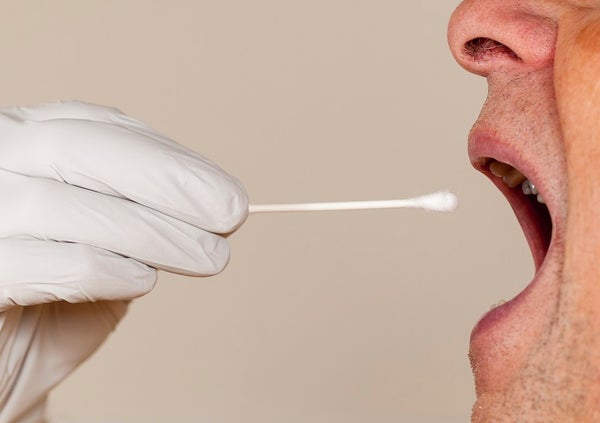

Every day, you produce one to two liters of spit. It kick-starts digestion and helps you swallow. And it helps prevent bacterial infection in your mouth.
"But that still seemed like a lot of energy put into something if it's only going to do that small task." Esther Bullitt, a biophysicist at the Boston University School of Medicine. "And we wondered whether there was something else it was doing as well, if maybe it had a farther reach than just preventing infections in the mouth."
So she and her team looked farther down the pipes—at whether certain proteins in spit might also disrupt the work of bad bugs in the gut. They grew cells taken from the small intestine of a 51-year-old woman. They also grew a batch of pathogenic E. coli bacteria, the kind that cause traveler's diarrhea. The E. coli have hairlike extensions, called pili, that grab onto the intestinal cells. But fewer of the E. coli were able to successfully attach to the intestinal cells when a particular saliva protein, called histatin-5, was hanging around.
On supporting science journalism
If you're enjoying this article, consider supporting our award-winning journalism by subscribing. By purchasing a subscription you are helping to ensure the future of impactful stories about the discoveries and ideas shaping our world today.
You can think of the E. coli like pirate ships, trying to dock at a port. What the histatin-5 does is stop the pirate ships, the bad bugs, from using their ropes—the pili—to dock. "If you can't bind, then you can't start an infection. So no adhesion, no infection, no disease."
The study is in The Journal of Infectious Diseases. [Jeffrey W. Brown et al., A Role for Salivary Peptides in the Innate Defense Against Enterotoxigenic Escherichia coli]
The salivary protein can be chemically synthesized; stored as a powder; and dissolved in water. And presumably, the resulting liquid is safe. "You know that your body tolerates it, because you swallow one to two liters of it every day." No word yet on whether it might someday be available at the drugstore. But the good news is: you're already swallowing some right now.
—Christopher Intagliata
[The above text is a transcript of this podcast.]
