
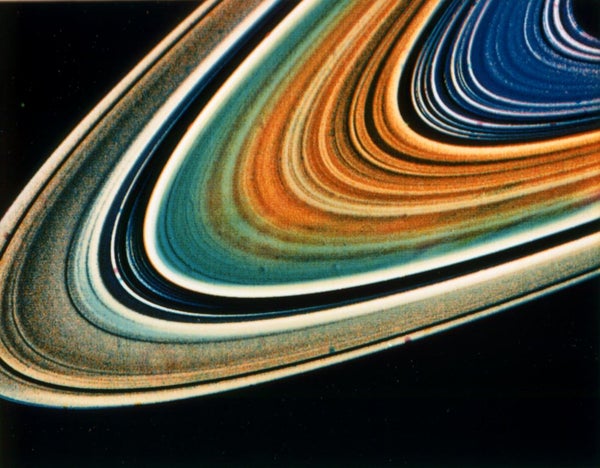

When it comes to Saturn, it’s the rings that render the planet instantly recognizable. But it turns out that Saturn was not always so elaborately adorned. Data from the final orbits of the Cassini mission indicate that Saturn’s rings were a relatively recent addition…forming a scant 100 [million] to 10 million years ago. The findings are in the journal Science. [Luciano Iess et al., Measurement and implications of Saturn’s gravity field and ring mass]
During what’s been called the “grand finale” phase of the Cassini mission, the spacecraft repeatedly dove through the gap between the top of Saturn’s clouds and the innermost edge of its rings. These flybys allowed researchers to separate the gravitational effects of the planet and its accessories…which led to a more precise measurement of the rings’ mass.
“Their mass was the missing piece of the puzzle to determine their age.”
On supporting science journalism
If you're enjoying this article, consider supporting our award-winning journalism by subscribing. By purchasing a subscription you are helping to ensure the future of impactful stories about the discoveries and ideas shaping our world today.
Daniele Durante, a postdoc at Sapienza University in Italy, who analyzed the data.
“The rings are made up mostly of ice with a small fraction of impurities. About one or two percent of the total rings’ mass. These impurities consist of rocky material coming from outer space. Since these impurities are accumulated over time, these allow us to relate the total mass of the rings with their age."
Durante and his colleagues found that Saturn’s bling has a combined mass of about one-and-a-half to two times 10 to the 19th kilograms…that’s less than half the mass of its smallest moon. And when they crunched the numbers, the data suggested an age of no more than 100 million years. To put that in context, remember, dinosaurs roamed the earth from about 200 million years ago until 65 million years ago. And Saturn itself, like planet Earth, formed early in the life of the solar system, about 4.5 billion years ago.
“Therefore, the ring’s formation came long after that of the planet.”
The youthful accoutrement might have come from a captured comet or a pulverized moon. But no matter how they were made, the rings really do make Saturn a solar system standout.
—Karen Hopkin
(The above text is a transcript of this podcast)
