
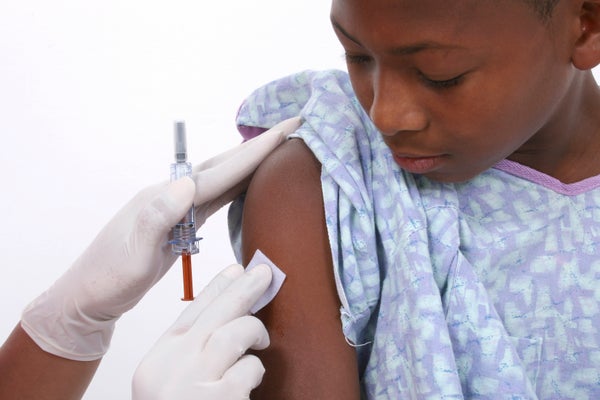

Getting a vaccine can be a painful experience, especially when you’re a kid. But getting told the shot might “hurt a bit” could actually make it worse.
“We know that expectation affects pain experience in adults. But we don’t really know whether this is also true for children.”
Kalina Michalska, a developmental neuroscientist at the University of California, Riverside. She led a study to find out.
On supporting science journalism
If you're enjoying this article, consider supporting our award-winning journalism by subscribing. By purchasing a subscription you are helping to ensure the future of impactful stories about the discoveries and ideas shaping our world today.
The study included 25 adults and 48 children. And 27 of the kids had a pre-existing anxiety disorder. Because medical procedures make pretty much all kids anxious…and those who are anxious to start with tend to find the experience even more painful.
The researchers used a handheld wand to apply heat to the forearm of each participant. And they asked subjects to rate the temperature in terms of discomfort. The hottest setting was about the temperature of very warm tap water—uncomfortable, perhaps, but not damaging.
But during the experiment, we were most interested in only one temperature: the one that each subject rated as medium.
That’s where the “anticipation” part of the experiment comes in. Subjects were played one of two tones.
“One tone meant that low heat was coming; the other meant that high heat was upcoming.”
But here’s the sneaky part. No matter what tone was played, participants got the same heat applied—the one rated as “medium.”
“So even though the subject heard a cue indicating high pain or low pain, the pain was only medium.”
Or at least that’s how it should have felt. But what happened was that subjects reported feeling what they thought they would.
“If we tell them through this tone that they’re going to experience a lot of pain, they’ll actually experience more pain: they rated the pain as higher. And conversely, if we tell them that they will experience only low pain, they also rate their experiences as less painful.”
“This is really important because it kind of reinforces the necessity of not hyping up painful experiences. And also discouraging children from ramping up the experience in their head."
And the same, it seems, goes for the grownups.
“One aspect surprised us, was that all three groups experienced a similar relationship between pain expectation and pain experience. We expected the strongest correlation among anxious children. But however all three groups showed a very large effect of expectancy on their experience of pain.”
The research is in the journal Psychosomatic Medicine. [Kalina J. Michalska et al., Anticipatory effects on perceived pain: Associations with development and anxiety]
Next up, Michalska says she’d like to examine whether negative associations can be unlearned. So next time you need a shot, remember: if you think it won’t be so bad, maybe it won’t be.
—Karen Hopkin
[The above text is a transcript of this podcast.]

