

This is Scientific American’s 60-Second Science. I’m Jeff DelViscio.
Today: part two of our three-part sound escape series to the Amazon rain forest. In this episode, we’re going into the dark. Make sure to catch the first episode on the mysterious pink river dolphin after you listen to this one.
Again joining us is Tim Weaver, a professor of emergent digital practices and a multimedia and sound artist at the University of Denver. Tim has traveled to the Amazon for years to collect what he calls the acoustic plenitude that’s there. But before we listen to that plenitude, let’s talk about a phenomenon with a strange name: the “Sharawadji effect.” Tim, what is that exactly?
On supporting science journalism
If you're enjoying this article, consider supporting our award-winning journalism by subscribing. By purchasing a subscription you are helping to ensure the future of impactful stories about the discoveries and ideas shaping our world today.
“The Sharawadji effect is actually an approximation of the psychoacoustics that are happening.”
Psychoacoustics—that is the branch of psychology concerned with the perception of sound and its physiological effects. Thanks, Oxford dictionary.
“I liken it to acoustic hallucination. What I’ve experienced is like: here you’re in the Amazon basin, where all the drainage is going from the Andes down there, and it’s like the voices of the ancestors are speaking to you is what I’ve experienced. But it may be composed of this incredible array of night choruses that are going on, and it can happen in the day as well. So it’s like this polyphonic of mixtures emits new voices, and it’s pretty profound.”
Tim encountered one of those Sharawadji effect moments on the sound escape he’s taking us on today, and it came courtesy of a riot of ribbits.
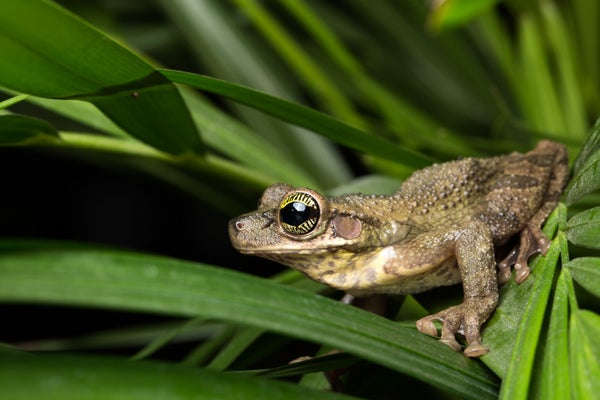
“In the Amazon, there is an amazing diversity of amphibians. And frogs, of course, are one of those. And the night is an amazing time to be wandering around, provided you don’t step on the wrong species. So this is a path of roaming through the main story of a primary forest of multiple frog species that are voicing. The frogs—some of them are gigantic, they’re the size of a football, and some of them are the size of a thumb. And they make an incredible diversity of calls to make up the night chorus of the rain forest. And these were recorded within an ambisonic mic, so it’s recording in three-dimensional sound, but we're bringing it back in the stereo.”
Maybe this is a good time for us to just close our eyes and enter the Amazon at night.
[CLIP: Amazonian frog chorus sounds]
Thank you, Tim, for sharing your work with us on the 60-Second Science podcast.
“Yes, I think that’s there’s more incredible communication going on on the planet besides our own din of craziness that’s going on, so there is solace out there that we should listen to and also an incredible array of and diversity of organisms that also need listening and communication space.”
And thank you to all of our listeners for taking this trip with us. Make sure to join us for the next and final episode of this Amazon sound escape, coming soon to the podcast. A little hint: in the next episode, we’ll get high.
[The above text is a transcript of this podcast.]
