
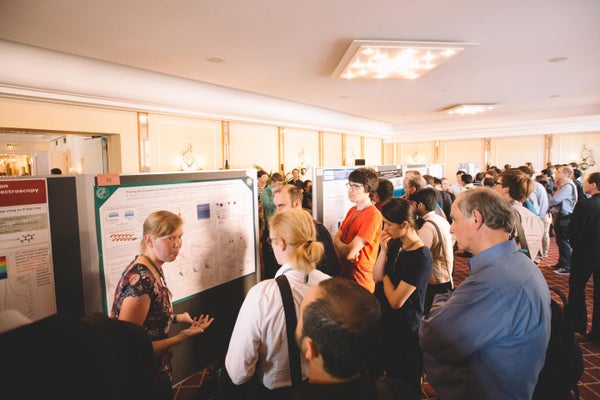

If you attend science conferences, ever pay attention to who in the audience asks questions? Geneticist Natalie Telis did. And she noticed something ... off. "For the entire first day of the conference, I was the only woman to ask a question. And I thought, wow, that's kind of weird, right?"
So, being a scientist, she decided to systematically study who asks questions at scientific conferences. Together with colleagues from Stanford University, where she was based at the time, and Emory University in Atlanta, she recorded more than 2,000 questions from hundreds of talks at eight different scientific conferences.
After assigning either male or female designations to question askers—which the researchers acknowledge in the paper doesn't fully capture the spectrum of gender identity—they found that women ask far fewer questions than a representative result based on their numbers. In fact: "You need about 85 to 90 percent of your room to be women before 50 percent of your questions come from women."
On supporting science journalism
If you're enjoying this article, consider supporting our award-winning journalism by subscribing. By purchasing a subscription you are helping to ensure the future of impactful stories about the discoveries and ideas shaping our world today.
But Telis did identify a possible solution. Halfway through the Biology of Genomes conference in 2015, Telis started tweeting some of her preliminary findings about how few women had been asking questions compared to their relative numbers at the meeting. That information sparked a public discussion—and a policy change from the conference organizers, who instituted a rule that the first question at every talk had to come from a scientist still working towards her PhD, in the hope that the approach would produce a more diverse set of question-askers. And it worked.
"Before our intervention, about 11 percent of questions came from women, which is one third of what you'd expect. After our intervention, you get more like 35 percent of questions coming from women. It's actually what you'd expect from that audience."
The analysis is in the American Journal of Human Genetics. [Natalie Telis et al., Public Discussion Affects Question Asking at Academic Conferences]
Telis says that strategy of simply publicizing the problem has been effective at other conferences too, getting more women to not only attend, but to participate in scientific conferences.
"A lot of women have messaged me and said, 'Oh, you know, I asked my first question at a conference when I saw this work,' or stuff like that. And I hope that means people are taking advantage of that incredible opportunity to really add their voice, not just their face in the conference photo, to that scientific community."
—Christopher Intagliata
[The above text is a transcript of this podcast.]
