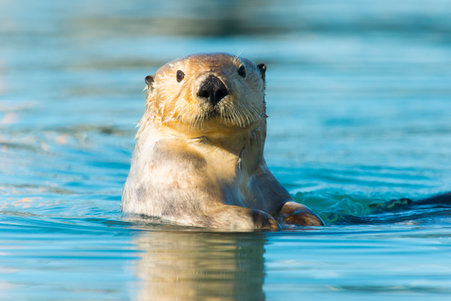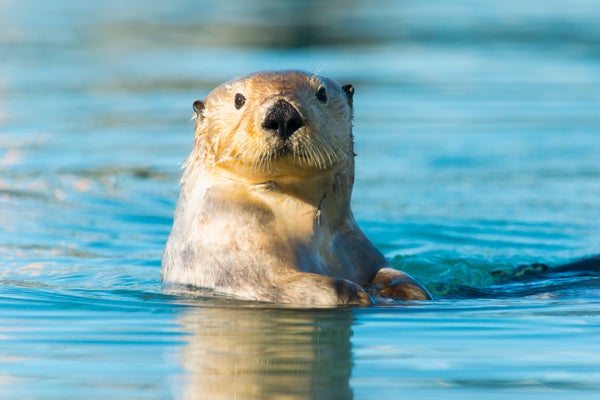

Sea otters are pretty petite compared to other marine mammals. Which means that, despite their fur coats, they tend to lose heat quickly, and need lots of energy to stay warm.
"So they need to eat 25 percent of their body weight each day." Sarah McKay Strobel, a sensory ecologist at U.C. Santa Cruz. "But in order to eat that much food, that means sea otters need to find all that food. And that's where we come in."
She and her team studied the otter's senses, to solve the mystery of how they're such efficient foragers. Vision isn't reliable, she says—it's pretty dark and murky underwater, and crabs and clams tend to hide. Hearing is also tough for otters, in the noisy underwater environment. And sniffing's no good either. "When they're underwater they're holding their breath."
On supporting science journalism
If you're enjoying this article, consider supporting our award-winning journalism by subscribing. By purchasing a subscription you are helping to ensure the future of impactful stories about the discoveries and ideas shaping our world today.
What's left is touch. So Stroble and her team measured the sensitivity of the otters' paws and whiskers. They blindfolded an otter named Selka, then presented her with plastic plates engraved with tiny grooves, like corduroy. Selka's job was to select the plate with two-millimeter grooves, which she'd been trained to associate with tasty shrimp, instead of plates with differently sized grooves.
Turns out, Selka could perceive just a quarter millimeter difference in the grooves' width with her paws—above and below water—and half a millimeter difference with her whiskers. "The fact she was able to perform so well while moving incredibly quickly I think is really interesting and suggests that sea otters have very quick decision making abilities, and very quick sensory processing abilities, which makes sense when you think about the type of lifestyle they lead and how quickly they need to find food."
The full details—and a cute photo of Selka—are in the Journal of Experimental Biology. [Sarah McKay Strobel et al., Active touch in sea otters: in-air and underwater texture discrimination thresholds and behavioral strategies for paws and vibrissae]
For the record, humans can feel the difference too, but it takes us 30 times longer. Which might make sense. After all, we evolved in environments where touch was less important in a hunt than were sight and sound.
—Christopher Intagliata
[The above text is a transcript of this podcast.]