

March 27th, 1964: the world's second-most powerful recorded earthquake hits Alaska. <<historic movie clip: "In Anchorage, Alaska's largest city, buildings collapse. Streets and homes slip into the Earth…Out in the Gulf of Alaska the ocean bottom seems to sink. Then heaves upward 50 feet, sending a giant wave towards shore.">>
"What happened was the whole Gulf of Alaska and Prince William Sound just sort of tilted, and so near shore, near Alaska, that region sank. And then out at sea, the sea floor raised up." Susie Bassham, a molecular biologist at the University of Oregon. "And so things that were submarine platforms before suddenly were lifted above sea level, and then silt could come in and build more island."
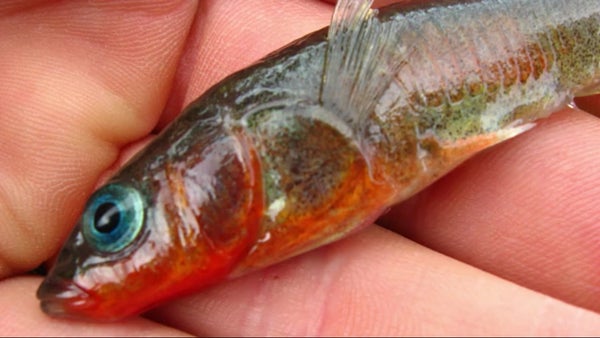
And with more island, came new freshwater ponds. Those newly created bodies of water turned out to be the testbed for a natural evolutionary experiment on a finger-sized fish, called the three-spined stickleback. Saltwater fish went in… freshwater fish came out. "Big silvery well-armored fish entered freshwater ponds. And during the last 50 years they changed their size, their coloration, they changed the size of their eyes, the length of their spines, many aspects of their skeletons, feeding structures, swimming structures, and became more stereotypical freshwater fish." But how?
On supporting science journalism
If you're enjoying this article, consider supporting our award-winning journalism by subscribing. By purchasing a subscription you are helping to ensure the future of impactful stories about the discoveries and ideas shaping our world today.
Bassham and her colleagues ran statistical analyses on the genomes and body measurements of fish living in those freshwater ponds today. And they found that the saltwater versions of the fish may have actually colonized those freshwater ponds on the study islands at least six times in the last 50 years. They were able to move in and rapidly adapt because the sea-dwelling fish have a sort of "sleeper genome" of freshwater traits, just waiting to be activated.
"These are anadromous fish that have been invading freshwater ecosystems over and over and over. And all those freshwater adaptations have trickled back into the sea, allowing the oceanic population, which is believed to be the ancestor of all the freshwater populations, to maintain this huge resource of differently, alternately adapted genotypes that are just waiting to get back into a freshwater system." And when they do, it takes just several dozen generations—instead of thousands of years—for this evolution to occur. The findings are in the Proceedings of the National Academy of Sciences. [Emily A. Lescak et al, Evolution of stickleback in 50 years on earthquake-uplifted islands]
Not all species, of course, have a genome that makes it easy to respond to sudden environmental challenges, the kind we’re seeing with climate change. "For instance corals are very adapted to live in a very narrow temperature range. And there is no genetic diversity to call upon there." But there may be a few species, she says, in possession of the kind of genetic toolkit that enables sticklebacks to deal with adversity so swimmingly.
—Christopher Intagliata
[The above text is a transcript of this podcast.]
