
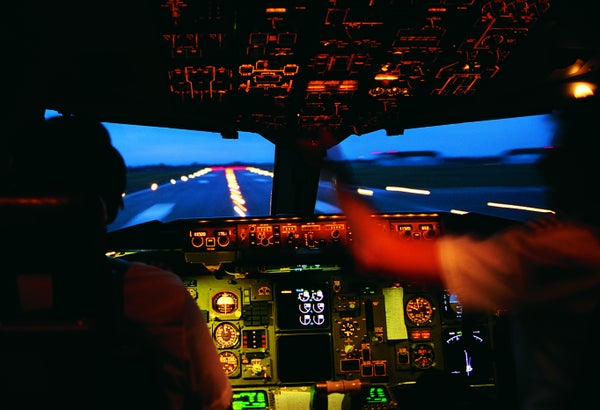

In March 2015, the co-pilot of Germanwings Flight 9525 crashed the jet into the French Alps, killing himself and 149 others. Later on, investigators found out he'd googled poisons, and living wills. And he'd previously been treated for severe depression. And yet, his mental illness was mostly ignored by Lufthansa, the airline’s parent company.
After the crash, researchers with the Harvard School of Public Health reached out to commercial pilots worldwide, advertising an anonymous survey about pilot health. Among other topics, it had a short section on mental health. The investigators found that nearly 13 percent of the 1,800 pilots surveyed met the standard criteria for depression. And seventy-five of them had had suicidal thoughts within the last few weeks. The study is in the journal Environmental Health. [Alexander C. Wu et al., Airplane pilot mental health and suicidal thoughts: a cross-sectional descriptive study via anonymous web-based survey]
Couple caveats: the researchers didn't clinically diagnose the pilots. And they can't compare rates of suicidal thoughts in pilots to rates you'd find among the general population, due to sampling issues. Still, you're probably wondering: should you be worried?
On supporting science journalism
If you're enjoying this article, consider supporting our award-winning journalism by subscribing. By purchasing a subscription you are helping to ensure the future of impactful stories about the discoveries and ideas shaping our world today.
"The answer is no." Alexander Wu, a doctoral candidate in occupational epidemiology. "The data strongly support the fact that traveling by air is by far the safest form of public transportation. And our study does not change that fact. And we want everyone to know that for sure. They should not be afraid to fly." Still, he and his co-authors recommend that airlines boost their support for preventative mental health treatment. To make sure it's friendly skies for passengers—and pilots—alike.
—Christopher Intagliata
[The above text is a transcript of this podcast.]
