
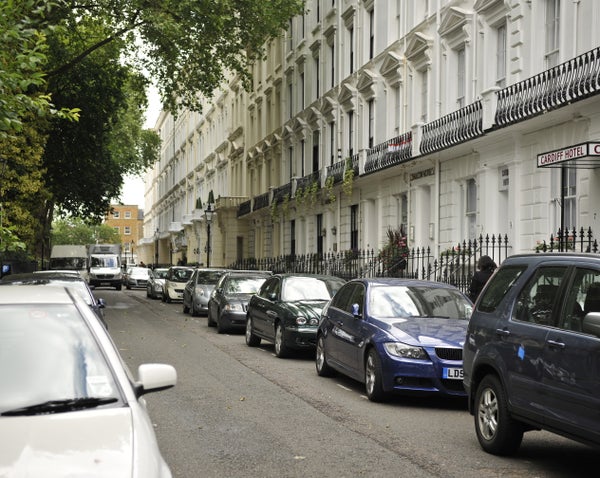

If you drive in a city, you've no doubt experienced the frustration of circling block after block, cruising for parking. But scientists who study that phenomenon have a solution to free up more spots:
"You make them more expensive, so people have to decide whether to park farther away and pay less, or closer and pay more." Itzhak Benenson, a system scientist at Tel Aviv University.
San Francisco has piloted a program that raises parking rates based on demand—and it's been shown to reduce cruising. But the sensors required for those systems can cost millions of dollars to install and operate, Benenson says. So instead, writing in IEEE Intelligent Transportation Systems Magazine, he and his colleague Nir Fulman describe an algorithm that can determine smart pricing, without the use of sensors. [Nir Fulman and Itzhak Benenson, Establishing Heterogeneous Parking Prices for Uniform Parking Availability for Autonomous and Human-Driven Vehicles]
On supporting science journalism
If you're enjoying this article, consider supporting our award-winning journalism by subscribing. By purchasing a subscription you are helping to ensure the future of impactful stories about the discoveries and ideas shaping our world today.
They tested it on the Israeli city of Bat Yam, near Tel Aviv. First, they divide the city into zones. They estimate the parking demand in each zone, by calculating the number of apartments and offices there. Then they factor in parking supply in the area, along with how wealthy potential parkers might be. Using that data, the algorithm suggested pricing for each zone that would guarantee a 90-percent occupancy rate of parking spots city-wide. Meaning 10 percent of spots were always available to drivers willing to pay the price, regardless of neighborhood.
Of course, not everyone will agree that jacking up parking prices will ease driver frustrations. Last time Benenson proposed hiking rates for city residents? "I got about 100 reactions on the web and 99 of them that said they have never heard such a stupid statement from the professors, and I should be punished and fired."
Ultimately, he says, it'll be up to cities themselves to gauge their residents' political appetites for an easier parking spot.
—Christopher Intagliata
[The above text is a transcript of this podcast.]

