
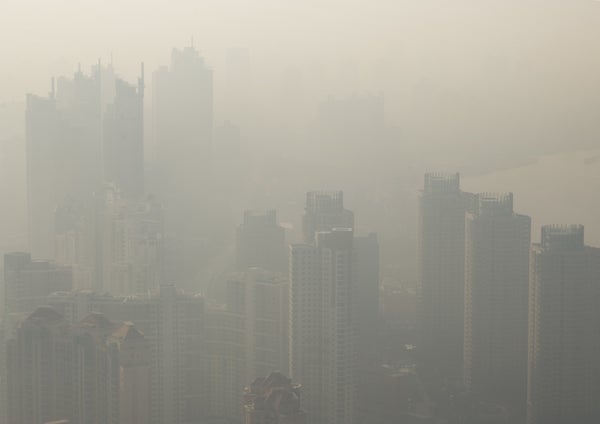

China is notorious for its heavy smog. "It's incredibly bad." Denise Mauzerall, an atmospheric scientist at Princeton. "The air pollution in eastern China can be so bad you can't clearly see across the street. It can feel like you're walking through a heavy fog that's burning your lungs."
But smog has other damaging effects too. Mauzerall and her team have found that in winter months the smog in China's northeastern provinces is so severe it blocks more than 20 percent of sunlight from reaching the region's solar panels.
The findings, based on satellite data and photovoltaic performance models, are in the Proceedings of the National Academy of Sciences. [Xiaoyuan Li et al., Reduction of solar photovoltaic resources due to air pollution in China]
On supporting science journalism
If you're enjoying this article, consider supporting our award-winning journalism by subscribing. By purchasing a subscription you are helping to ensure the future of impactful stories about the discoveries and ideas shaping our world today.
One solution to the problem might be installing even more solar. "There's this virtuous cycle—whereas if you use more solar electricity, you can reduce your use of coal. And that will reduce the air pollution levels, and that will then allow you to generate more solar electricity."
China hopes to harvest 10 percent of its electricity from solar by 2030. They'll need 400 gigawatts, or about 10 times what we have installed in the U.S. today. It's an optimistic forecast for solar… and hopefully, for China's air quality, too.
—Christopher Intagliata
[The above text is a transcript of this podcast.]
