
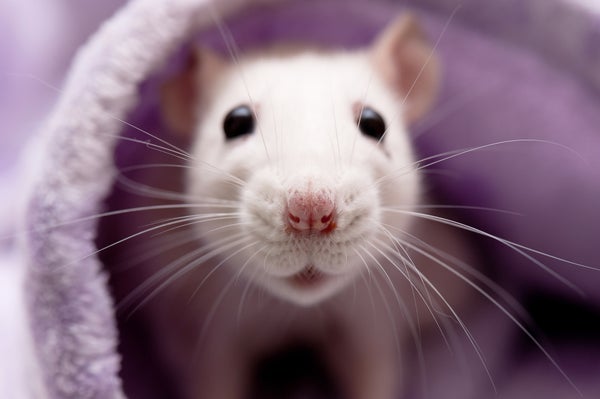

Mice and rats vocalize. To us, many of the sounds they make are ultrasonic—at too high a frequency to hear. But if we slow the calls down, they sound like squeaks. And not all squeaks are the same. The sounds that rodents make when they are excited versus disappointed can be quite different.
For example, here’s slowed-down audio of a rat drinking sugar water.
[Rat squeak clip]
On supporting science journalism
If you're enjoying this article, consider supporting our award-winning journalism by subscribing. By purchasing a subscription you are helping to ensure the future of impactful stories about the discoveries and ideas shaping our world today.
But this rat [different squeak] got played—it got non-sweetened water after becoming accustomed to sugar water.
“Calls around 22 kilohertz are usually associated with unhappy affect and calls around 55 kilohertz are happy affect.”
John Neumaier, a professor of psychiatry and pharmacology at the University of Washington.
“So if you tickle a rat, it puts out a lot of 55 calls. If we give them a sucrose solution, then they put out a lot of calls at 55 kilohertz.”
Being able to interpret these different calls can help researchers understand the rodent’s emotional state—which could affect the results of experiments on the animals.
Of course, listening to rodents in real time eats up resources. To code one hour of a recording,
“It takes 10 hours, you know, because you have to slow these recordings down in order to be able to listen to them.”
To automate the process, Neumaier’s associates, Kevin Coffey and Russell Marx, used machine algorithms originally designed for self-driving cars to develop software that they call DeepSqueak. The program takes recordings of rodent squeaks and plots them by frequency and intensity. By transforming the audio to a visual representation,
"They were able to train the computer network to recognize what ultrasonic vocalization looks like and then to easily tell them apart from other kinds of noise."
The description of DeepSqueak is in the journal Neuropsychopharmacology.
[Kevin R. Coffey, Russell G. Marx and John F. Neumaier, DeepSqueak: a deep learning-based system for detection and analysis of ultrasonic vocalizations]
The researchers have made the software available to any other scientists working with rodents who could use this kind of analysis.
"In my mind it will democratize this kind of research so that people can afford to do it, because it's been a huge barrier."
[Squeak noises]
—Lucy Huang
[The above text is a transcript of this podcast.]
