
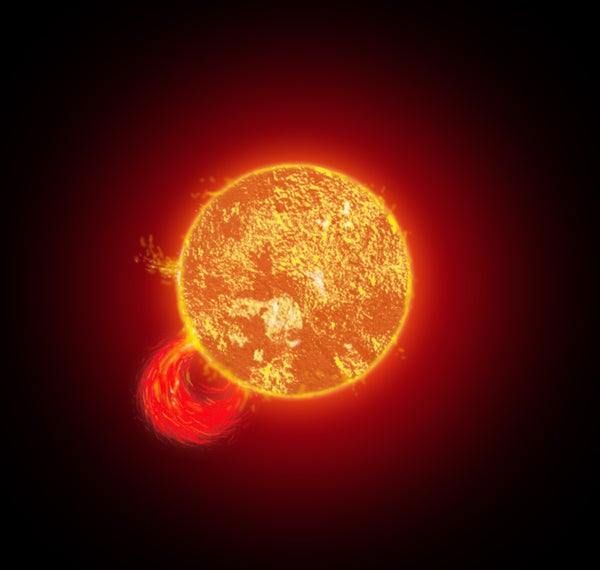

As astronomers hunt for habitable, Earth-like worlds, one popular place to look is around M stars, a type of red dwarf. Couple reasons for that:
"First of all most of the stars in our galaxy are like that." Eike Guenther is an astronomer at the Thüringer State Observatory in Germany. "And secondly the closest stars to us are like this. And thirdly, it's relatively easy to find planets around them which have a low mass or small diameter."
M stars are smaller and fainter than our Sun. Meaning the zone around them where liquid water could exist—the habitable zone—is really close in. And in that region around the star it’s also easier to spot small exoplanets, with current techniques.
On supporting science journalism
If you're enjoying this article, consider supporting our award-winning journalism by subscribing. By purchasing a subscription you are helping to ensure the future of impactful stories about the discoveries and ideas shaping our world today.
A few months back, Guenther had his telescope trained on an M star 16 light-years away, known as AD Leonis, when he spotted a huge stellar flare. A Neptune-sized giant exoplanet lurking around the star appears to have survived unscathed. But the event inspired Guenther and his team to ask how that huge flare would have affected a hypothetical Earth-sized exoplanet orbiting the star. So they ran a computer simulation.
The result? The shower of X-rays, thousands of times stronger than what the Sun unleashes on the Earth, would have blasted away much of the imaginary exoplanet's protective ozone. And multiple such flare events would be disastrous for life as we know it.
"So this analog, of taking the Earth, and saying, 'Ok, we put it in the habitable zone, and that's how a habitable planet looks like’—that's presumably wrong. One now has to consider these very energetic events that change the properties of the atmospheres of the other planets."
He presented the observations at the recent European Week of Astronomy and Space Science conference in Liverpool. [Eike Guenther, Flares and CMEs in M-stars]
Guenther says, if anything, this finding makes the weird planets hugging M-stars even more intriguing, in terms of planetary diversity. "I would say… keep looking!"
NASA's Transiting Exoplanet Survey Satellite, or TESS, is set to launch April 16th… if all goes well… it'll soon be looking too.
—Christopher Intagliata
[The above text is a transcript of this podcast.]
