
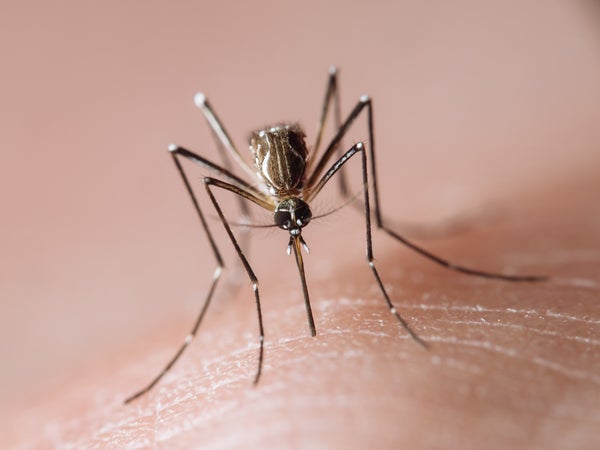

It might seem obvious that the primary function of insect repellents like DEET is to, well, repel. But if you bring a pipette tip full of DEET right up to a mosquito, as Johns Hopkins neuroscientist Chris Potter did:
“She just ignores it. So that really does demonstrate that DEET by itself is not repellent, and it’s not going to make them fly away.”
Potter’s team also genetically engineered Anopheles mosquitoes to make their antennae light up when their olfactory neurons picked up on a scent. But when they spritzed the antennae with DEET and other so-called repellents, even at 100 percent strength:
On supporting science journalism
If you're enjoying this article, consider supporting our award-winning journalism by subscribing. By purchasing a subscription you are helping to ensure the future of impactful stories about the discoveries and ideas shaping our world today.
“There just was no response. So that was a surprise to us. Going into this, we thought, ‘Okay, they’re insect repellents. They’re going to activate neurons; that’s how they repel mosquitoes.’ So then the question is, ‘What are they actually doing?’”
The researchers kept experimenting with those genetically modified mosquitoes to find out. A whiff of molecules commonly found on human skin made the mosquitoes’ antennae light up like a Christmas tree, Potter says. So they do sense us, which you’ve likely experienced. But when they combined compounds from our natural human perfume with DEET and other synthetic repellents, the antennae just flickered dimly.
“So these odors, which, before, would strongly activate the olfactory system, essentially now didn’t do anything.”
Meaning repellents like DEET actually act like an invisibility cloak against mosquitoes. The details are in the journal Current Biology. [Ali Afify et al., Commonly used insect repellents hide human odors from Anopheles mosquitoes]
Natural repellents, on the other hand, like lemongrass oil, strongly activated the skeeter’s senses in a negative way. And they weren’t as affected by masking chemicals like DEET. So the scientists say maybe you could combine them—to both offend the mosquitoes’ senses and to mask the more irresistible scent—of you.
—Christopher Intagliata
[The above text is a transcript of this podcast.]
