

It may be one of the doggone doggiest things a doggy can do ...
[CLIP: Dog running and dropping a stick]
... chasing down a stick or a ball and then bringing it back.
On supporting science journalism
If you're enjoying this article, consider supporting our award-winning journalism by subscribing. By purchasing a subscription you are helping to ensure the future of impactful stories about the discoveries and ideas shaping our world today.
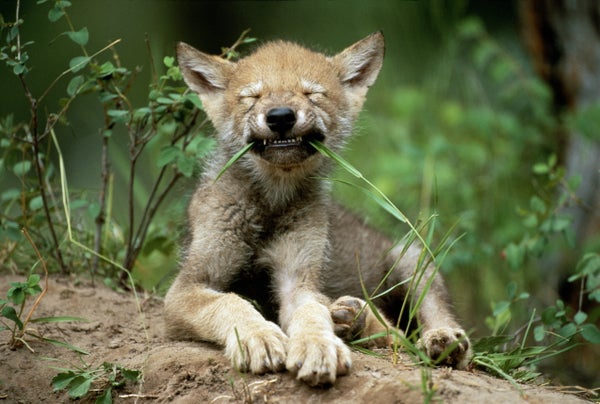
But when it comes to playing fetch, perhaps the apple doesn’t fall all that far from the evolutionary tree, because a new study shows that some wolf pups demonstrate the same innate fetching skill—a finding that suggests that an ability to playfully interact with people might have been around in ancient wolves before they transitioned into domesticated dogs some 15,000 years ago. The work is in the journal iScience. [Christina Hansen Wheat and Hans Temrin, Intrinsic ball retrieving in wolf puppies suggests standing ancestral variation for human-directed play behavior]
Researchers were interested in understanding how domestication affected canine behavior. So they raised several litters of both wolf and dog puppies and ran the little fur balls through a standard series of behavioral tests.
In one of those tests, a “puppy assessor”—someone the animals never before met—would toss a tennis ball across the room and encourage the pup to retrieve it.
Wolf pups in the first two litters tested showed little interest in playing ball. But three of the six pups in the third litter caught on quickly. Two wolves named Elvis and Lenny brought the ball back in two out of three throws, while the intrepid little Sting knocked it out of the park—and carried the ball back all three times.
These results were actually unexpected. The researchers had thought that the ability to socially engage with unfamiliar humans was something that likely arose after dogs were domesticated. The fact that a few of the wolf pups were up for some fun suggests that the potential for a connection between canines and people could have been present from the get-go, giving some wolves a leg up—or maybe even multiple legs up—in becoming our best friends.
—Karen Hopkin
[The above text is a transcript of this podcast.]
