
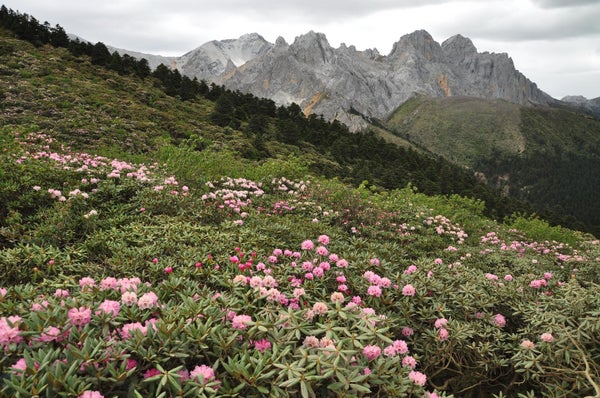

The tropics are well known for their biodiversity. But another hotspot? Mountains. Like the Hengduan Mountains, in south-central China.
"It'll look very much like this kind of familiar temperate alpine system, but the plant diversity there is off the charts."
Rick Ree is associate curator of botany at the Field Museum in Chicago.
On supporting science journalism
If you're enjoying this article, consider supporting our award-winning journalism by subscribing. By purchasing a subscription you are helping to ensure the future of impactful stories about the discoveries and ideas shaping our world today.
These mountains harbor a third of all China's plant species. And one hypothesis for mountain biodiversity is that mountain uplift creates new climates and habitats. "You'll see coniferous forests, limestone and granite outcrops with glaciers and rivers and alpine meadows."
Plants take advantage of the new niches, and diversify.
Now Ree and his colleague, Yaowu Xing, have evidence supporting the idea for connection between mountain building and biodiversity. They used DNA data to build an evolutionary tree of plants in the Hengduan. Then they calibrated the tree with fossil data. And they saw an explosion in diversification around eight million years ago—right when uplift occurred. The results are in the Proceedings of the National Academy of Sciences. [Yaowu Xing and Richard H. Ree, Uplift-driven diversification in the Hengduan Mountains, a temperate biodiversity hotspot]
So if new microclimates create new opportunities for diversification: what about global climate change? "If we look back on the history of life, one very striking pattern that we can see is that evolutionary diversification is pretty strongly associated with changing conditions. The flipside to change is that some species go extinct and some species diversify. So we're faced with both prospects I think going forward."
—Christopher Intagliata
[The above text is a transcript of this podcast.]
