
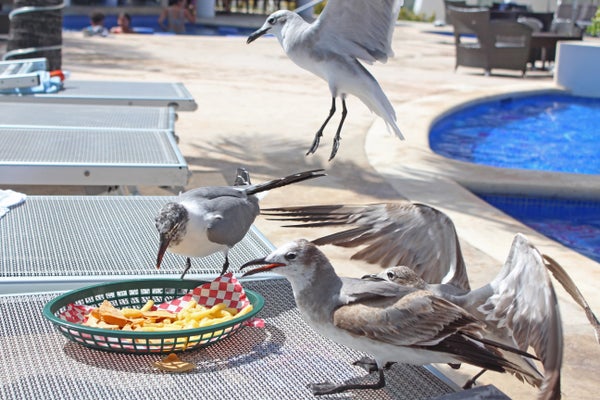

No trip to the beach would be complete without a swarm of hungry gulls. But don’t get distracted. Because one of those gulls may soon go after your food. “There’s a very small proportion of extremely bold individuals that seem to ruin the reputation of the whole species.”
Neeltje Boogert, an animal behavior researcher at the University of Exeter. She studied the food-snatching habits of gulls in seaside towns in the southern U.K. and found that very few—only the boldest—would actually take the bait. Or make that the bite.
The experiment went like this: A researcher crouched near a gull, then set out a plastic bag of french fries. For those brave gulls that then started to approach, the researcher either stared straight at the gull, as in “I see you, thief,” or the researcher simply looked away. And it turns out, staring down the gulls made them hesitate 21 seconds on average before approaching the fries.
On supporting science journalism
If you're enjoying this article, consider supporting our award-winning journalism by subscribing. By purchasing a subscription you are helping to ensure the future of impactful stories about the discoveries and ideas shaping our world today.
The results are in the journal Biology Letters. [Madeleine Goumas et al., Herring gulls respond to human gaze direction]
Gulls aren’t the only ones who behave better when being watched. A 2006 study found that people paid three times as much for their drinks at an unattended honor-system coffee bar when just an image of staring eyes was displayed nearby.
As for the gulls, Boogert points out that we need to learn to live with them—because the particular species she studied, the herring gull, is on the U.K.’s Red List of Birds of Conservation Concern.
“The thing is: people don’t want to have a seaside holiday without gulls. So it’s just trying to find ways to harmoniously live with one of the only wildlife species we still have around in these coastal areas.”
So don’t turn your back on the gulls, she says. Both figuratively for conserving the species and, of course, literally—for conserving your lunch.
—Christopher Intagliata
[The above text is a transcript of this podcast.]
