
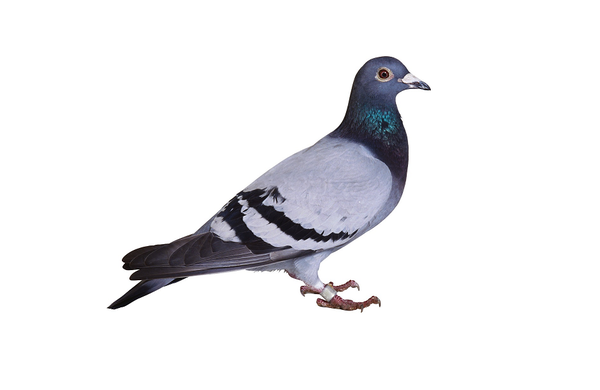

When he worked in a pharmacy in Portugal, Fernando Moreira often encountered people who stopped by for performance-enhancing drugs…for their racing pigeons. "Yes, I saw it very often."
Pigeon racing is big business. A bird named Bolt—as in Usain—sold for nearly half a million dollars a few years back. So there's a big incentive to breed faster birds. And to illegally obtain performance-enhancing drugs for them.
"Some doctors make prescriptions that are supposedly for the humans, for the owners of the pigeons. And then the owners of the pigeons administer those drugs to the animals."
On supporting science journalism
If you're enjoying this article, consider supporting our award-winning journalism by subscribing. By purchasing a subscription you are helping to ensure the future of impactful stories about the discoveries and ideas shaping our world today.
Moreira says that the pigeon fanciers, as they're called, freely admitted who the drugs were really for. And though the drugs can cause heart attacks in the avian athletes, there wasn't much he could do. "We cannot prohibit them to buy the drugs because they have a prescription."
And so Moreira headed to the University of Porto to get his doctorate. So he could figure out how to drug-test pigeons—and catch dopers in the act.
He and his team started by interviewing pigeon fanciers, anonymously, about their drugs of choice, so he'd know what to test for. They spiked pigeon poop with four popular doping compounds, a beta-blocker and three corticosteroids, and devised a test that uses mass spectrometry to quantify them.
Then, in a more real-world scenario, they doped two pigeons with a corticosteroid and successfully used their method to screen the birds' feces—a test that still works as many as three days after the pigeon is drugged. The results are in the Journal of Chromatography B. [Fernando X. Moreira et al., Quantification of doping compounds in faecal samples from racing pigeons, by liquid chromatography-tandem mass spectrometry]
Moreira's already been contacted by veterinarians interested in the test. And now that there's a way to quantify drug residues in pigeon poop, he says it'll be easier to keep owners who break the rules from improperly feathering their nests.
—Christopher Intagliata
[The above text is a transcript of this podcast.]
