Subtle Ancient Footprints Come to Light

Ground-penetrating radar can detect tiny density differences that lead to images of ancient footprints impossible to discern by eye.

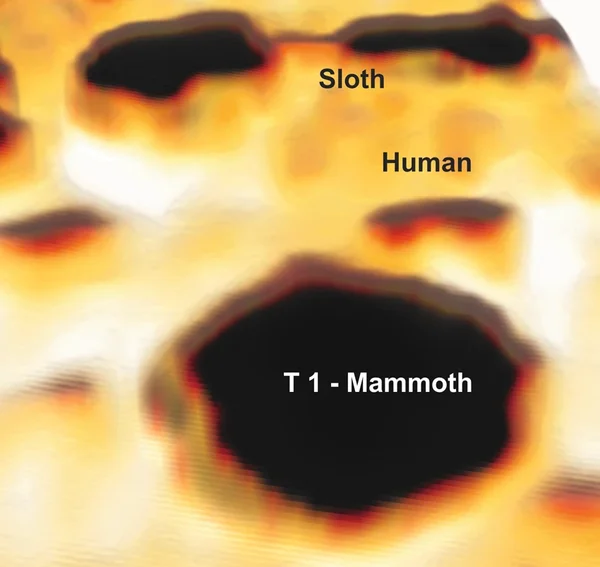
Three-dimensional ground-penetrating radar (GPR) perspective of mammoth track, along with human and sloth tracks. The presence of sloth tracks was not known prior to the GPR survey and was later confirmed.

Illustration of a Bohr atom model spinning around the words Science Quickly with various science and medicine related icons around the text

Join Our Community of Science Lovers!

Fossil footprints help tell us how ancient people lived. But such physical impressions are hard to find.

“You get all of these footprints from different species in the same time period interacting, and you can’t see them all the time. And some of them, you can never see—with the eye, that is. But we can we can still detect them with geophysical sensors.”

Cornell University archaeologist Thomas Urban. He and colleagues used ground-penetrating radar (GPR) to detect invisible traces of footsteps in White Sands National Monument in New Mexico. Their GPR device goes back and forth over an area in a grid pattern, which ultimately creates a 2-D radargram. The technique detects subtle differences in ground density.


On supporting science journalism

If you're enjoying this article, consider supporting our award-winning journalism by subscribing. By purchasing a subscription you are helping to ensure the future of impactful stories about the discoveries and ideas shaping our world today.


Speaking about one set of otherwise imperceptible animal’s footprints, he says:

“These were caused by compression of sediment beneath the animal’s track. And they relate to the weight and momentum of the animal.”

Twelve thousand years ago, the White Sands area was a large, muddy flat, which was covered with footprints from various species. Urban is excited about the stories so many footsteps suggest. For example, the researchers found no evidence of shoes or sandals. They did find human and animal tracks crossing each other—which suggests the prints were left during a hunt.

The findings are in the journal Scientific Reports. [Thomas M. Urban et al, 3-D radar imaging unlocks the untapped behavioral and biomechanical archive of Pleistocene ghost tracks]

“This sort of unique setting has recorded all of the daily movements of people. They are actually more than we even thought because there are always some that aren’t visible.”

These techniques could be applied to older sites all around the world, perhaps even to find dinosaur tracks that have been sitting quietly—waiting, at long last, to be found.

—Eliene Augenbraun

[The above text is a transcript of this podcast.]

Eliene Augenbraun is a multimedia science producer, formerly Nature Research's Multimedia Managing Editor and Scientific American's senior video producer. Before that, she founded and ran ScienCentral, an award-winning news service providing ABC and NBC with science news stories. She has a PhD in Biology.

More by Eliene Augenbraun

It’s Time to Stand Up for Science

If you enjoyed this article, I’d like to ask for your support. Scientific American has served as an advocate for science and industry for 180 years, and right now may be the most critical moment in that two-century history.

I’ve been a Scientific American subscriber since I was 12 years old, and it helped shape the way I look at the world. SciAm always educates and delights me, and inspires a sense of awe for our vast, beautiful universe. I hope it does that for you, too.

If you subscribe to Scientific American, you help ensure that our coverage is centered on meaningful research and discovery; that we have the resources to report on the decisions that threaten labs across the U.S.; and that we support both budding and working scientists at a time when the value of science itself too often goes unrecognized.

In return, you get essential news, captivating podcasts, brilliant infographics, can't-miss newsletters, must-watch videos, challenging games, and the science world's best writing and reporting. You can even gift someone a subscription.

There has never been a more important time for us to stand up and show why science matters. I hope you’ll support us in that mission.

Thank you,

David M. Ewalt, Editor in Chief, Scientific American

Subscribe