

The paleo diet—it's pretty trendy. Eat like a caveman, no dairy, grains, sugar and so on. But what you probably won't find on many paleo plates today?
"Pine nuts and moss and tree bark and mushrooms." Laura Weyrich, a paleomicrobiologist at the University of Adelaide in Australia. "What we would like to call the true paleo diet. It's basically what you could find in a forest if you're not eating meat."
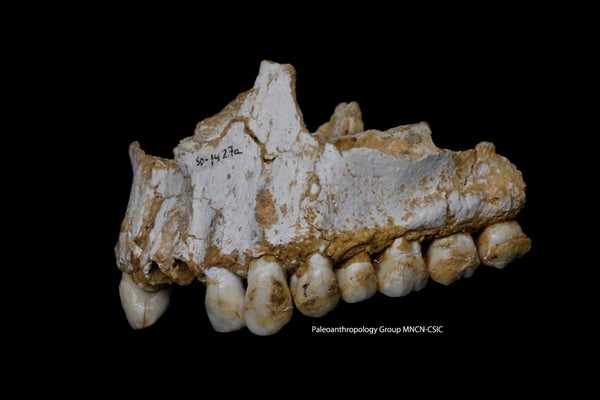
Weyrich and her colleagues cleaned the teeth of Neandertals found in Belgium and Spain. They popped off bits of ancient dental plaque, then sequenced the DNA contained within, to see if it matched up to any known sequences today.
On supporting science journalism
If you're enjoying this article, consider supporting our award-winning journalism by subscribing. By purchasing a subscription you are helping to ensure the future of impactful stories about the discoveries and ideas shaping our world today.
What they found suggests that the northern Neandertals ate a meat-heavy diet: including woolly rhino and wild sheep. Whereas their southern counterparts ate that forest-foraged vegetarian fare: mushrooms, nuts and moss. One of the Spanish specimens also appeared to have taken a tree-derived painkiller, related to aspirin—and might have self-medicated with antibiotic penicillium bacteria, too.
And the Neandertals' mouth microbiome, on average, resembled that of chimps more than modern humans. "They have a much healthier set of bacteria in their mouths as well. They don't have the right bacteria in the right proportions to chew holes in their teeth and cause periodontal disease. They really were very healthy." Their teeth, she says, are even sparkly white. The study is in the journal Nature. [Laura S. Weyrich et al., Neanderthal behaviour, diet, and disease inferred from ancient DNA in dental calculus]
Perhaps the most intriguing finding though, might be that humans and Neandertals appeared to swap mouth microbes at one point in time…something that Weyrich says probably happened not through violent interactions, but when kissing or sharing food.
"I think this paper in general just really suggests that Neandertals weren't like this caveman brute grunting-type animal they're often described as. They had knowledge about medicines, they had knowledge about their environments, about what they could eat, and they were having friendly interactions with other species. So it's a very different picture of Neandertals."
—Christopher Intagliata
[The above text is a transcript of this podcast.]
