
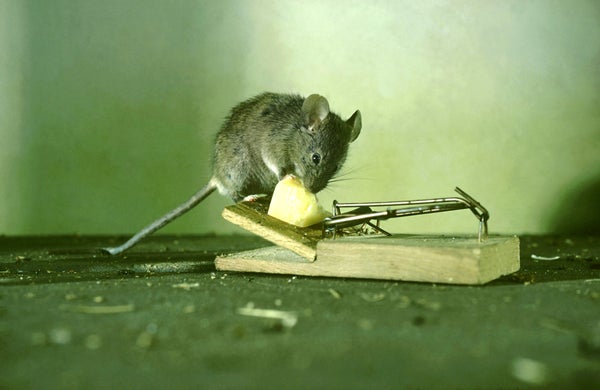

If you’ve ever hosted a mouse as a houseguest, you know they can be incredibly clever at finding your food. And that makes sense.
“They had to become better in traits like problem solving because we became better at hiding our food from them.”
Anja Guenther is with the Max Planck Institute in Germany. She says that battle of the minds has made mice craftier over time.
On supporting science journalism
If you're enjoying this article, consider supporting our award-winning journalism by subscribing. By purchasing a subscription you are helping to ensure the future of impactful stories about the discoveries and ideas shaping our world today.
“The longer the mice lived with humans, the better they are at problem-solving.”
You see, there are more than a dozen subspecies of house mice worldwide. And each began cohabitating with humans at different times in our evolutionary history. For example ...
“Mus musculus domesticus.”
It began raiding human pantries around 12,000 years ago.
“Mus musculus musculus.”
Our relationship with them began some 8,000 years ago.
“And Mus musculus castaneus.”
It’s a relative newcomer who began cohabitating only 3,000 to 5,000 years ago.
And that spread in evolutionary life histories, with constituents from all three groups, gave Guenther’s team an opportunity. They gathered 150 mice—representing all three groups—and tested them with seven different food puzzles. Each puzzle was baited with a mealworm, which the mice could only get by pushing or pulling a lid, for example, or extracting a ball of paper from a tube or opening the window of a Lego house.
And they found that the longer a mouse variety had lived with humans, the more likely it was to solve these food puzzles.
“So, basically, what we are left at, with trying to explain these results that we see, is that the mice really developed higher enhanced cognitive abilities while living with humans.”
The results appear in the Proceedings of the Royal Society B. [Lara Vrbanec et al., Enhanced problem-solving ability as an adaptation to urban environments in house mice]
As the human footprint on the globe expands, Guenther says it’s more important than ever to understand how we influence animal minds to learn why some creatures, like housemice, adapt—while others simply die out.
—Christopher Intagliata
[The above text is a transcript of this podcast.]
