
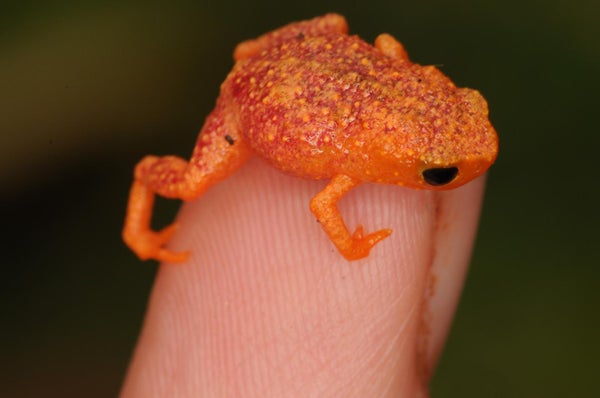

In the frog world, romance is often accompanied by a song. "It's the norm. The vast majority of frogs have males calling to attract females."
Sandra Goutte is an evolutionary biologist and herpetologist at the University of Campinas, in Brazil. And she studies frogs called 'pumpkin toadlets' from the cloud forests of coastal Brazil. "They're extremely cool, they're teeny tiny." They're neon orange, and they wave their arms around when they feel threatened, "by either predator or herpetologist."
And, true to frog form, "they make this slow call that sounds like a cricket, like "che che."
On supporting science journalism
If you're enjoying this article, consider supporting our award-winning journalism by subscribing. By purchasing a subscription you are helping to ensure the future of impactful stories about the discoveries and ideas shaping our world today.
But here's the weird part: it appears the pumpkin toadlets are not able to hear the sounds they make. Goutte and her colleagues playing recordings of the calls to the frogs to look for reactions. The researchers also traced electrical impulses from the frogs' ears to their brains, and even dissected the frog inner ear.
And it turns out, the frogs just don't have the equipment to hear their own voices. The study is in the journal Scientific Reports. [Sandra Goutte et al., Evidence of auditory insensitivity to vocalization frequencies in two frogs]
"Why would they call if they cannot hear their own calls, right?" Goutte does have a few theories. Perhaps, she says, the bulging throat movement associated with calling is a sexual signal, with the sound an inadvertent accompaniment—perhaps the frogs lost the ability to hear the calls at some point in their evolutionary history, when the displays did the job well enough on their own. After all, they're a highly visual species—out during the day, brightly colored, do the hand-waving thing.
Pumpkin toadlets are the only species unable to hear themselves. At least, as far as we know. "The thing is, it was really hard to convince even some of the co-authors to do the experiments, because they were like, 'Why would you test their hearing? If they're calling, they hear, they must hear, right?' So I think it's also the way we're doing science—we're not testing these obvious things. So maybe there are more examples out there but we don't know any yet." One can only hope that future research proposals will get a fair hearing.
—Christopher Intagliata
[The above text is a transcript of this podcast.]
