

In the science fiction story Dune, the desert planet Arrakis is inhabited by enormous, fearsome sandworms.
[CLIP: “Gods, what a monster.”]
They blast out of the dunes to swallow vehicles whole. They also looked sort of familiar to Caltech geneticist Paul Sternberg.
On supporting science journalism
If you're enjoying this article, consider supporting our award-winning journalism by subscribing. By purchasing a subscription you are helping to ensure the future of impactful stories about the discoveries and ideas shaping our world today.
“They look like nematodes. You know, anything in the popular culture that has a relationship to worms, we follow.”
Nematodes, of course, are much smaller than sandworms. “Most nematodes, you can just barely see.” And they’re much slower: “These worms would probably take 100 years to get across the U.S. if they could do it, and they went continuously day and night.”
Even so:
“They're pretty scary when you look at them up close.”
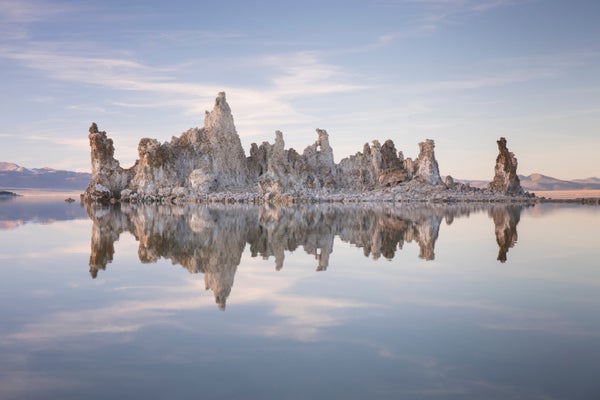
Sternberg and his colleagues had a hunch they might find nematodes lurking in one of California’s most extreme habitats: Mono Lake, on the east side of the Sierra Nevada. It’s supersalty, alkaline and loaded with arsenic—and, previously, known to harbor only two animal species: brine shrimp and alkali flies.
So the researchers took soil samples at beaches around the lake. And indeed, they found eight species of nematodes living there! “So we just went from two animals to at least 10 species. So that’s what's kind of striking. So are there gonna be others in the lake? Yeah! People should go look.”
Photos and details are in the journal Current Biology. [Pei-Yin Shih et al., Newly identified nematodes from Mono Lake exhibit extreme arsenic resistance]
Sternberg and his colleagues were able to culture one of the worm species in the lab. They discovered that it could survive 500 times the dose of arsenic that would kill a human. But they also found that even nematodes that weren’t from Mono Lake seemed to have the genetic ability to resist the lethal element—meaning the worms may be natural-born extremophiles.
“From the worm’s perspective, invading a host is a harsh environment. So I think there’s some general ability of the nematodes to adapt to harsh environments.”
Like maybe Mars?
“I have a fantasy that we should send nematodes. It would be really interesting if we could get the nematodes to photosynthesize—or carry photosynthetic organisms.”
Of course, that scenario is in the realm of science fiction. For now.
—Christopher Intagliata
[The above text is a transcript of this podcast.]
