
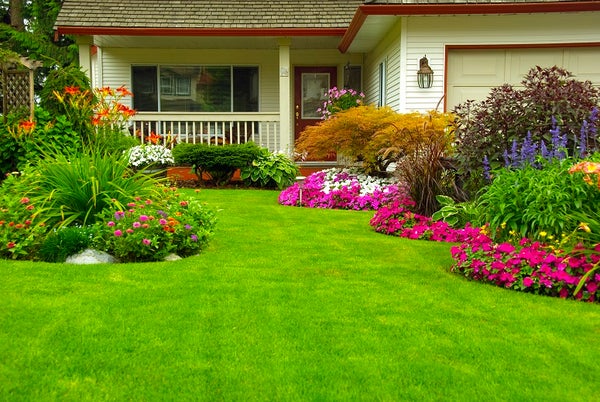

When California was strangled by drought, the city of Los Angeles was offering homeowners cash to replace their lawns with landscaping that was less thirsty. Because water just evaporates from overwatered lawns. But how much?
"So that turned out to be a lot of water." Diane Pataki, an ecologist at the University of Utah. "It turned out to be 70 billion gallons of water a year."
Pataki and her team got that number using a combination of real-world sensor data and modeling. And they found that, of water wasted specifically in urban landscaping, lawns were to blame for three quarters, with L.A.'s six million trees accounting for the rest.
On supporting science journalism
If you're enjoying this article, consider supporting our award-winning journalism by subscribing. By purchasing a subscription you are helping to ensure the future of impactful stories about the discoveries and ideas shaping our world today.
The study also uncovered something these ecologists were not expecting to study: economic disparity. "The amount of vegetation is really closely related to affluence. So in L.A. that means wealthy neighborhoods actually have twice the evapotranspiration of poorer neighborhoods." Meaning low income neighborhoods not only miss out on that greenery: but also the natural, built-in cooling effect of evapotranspiration. The findings are in the journal Water Resources Research. [E. Litvak et al., Evapotranspiration of urban landscapes in Los Angeles, California at the municipal scale]
Finally: if you think native trees are the solution to water waste? Think again, Pataki says. "Some of the highest water users in L.A. are those species, including the native California sycamore, which is a very, very popular tree." The reason being that southern California doesn't have a lot of native trees, except alongside rivers—meaning they're water guzzlers by nature.
Better, she says, to plant other species that thrive in Mediterranean climates, like water-thrifty pines and palms. Because even if the drought comes back, she says, L.A.'s secret to staying green may be its trees. "It doesn't take a lot of water in terms of absolute gallons to keep them alive. So moving forward L.A. could be very water efficient and maintain a very extensive tree canopy, which I think is good news."
—Christopher Intagliata
[The above text is a transcript of this podcast.]
