
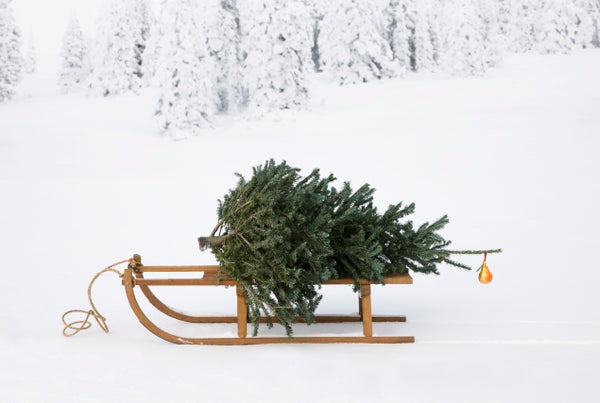

Given much thought to the afterlife of your Christmas tree? Your city might recycle it into compost or mulch. Or it might rot in a landfill, releasing methane, a potent greenhouse gas. But seen through the eyes of a chemical engineer?
"I thought, ok, this could be a good resource." Cynthia Kartey of the University of Sheffield. She says the needles are 85 percent lignocellulose—a tough woody material. But using heat and cheap solvents, Kartey says she can transform pine needles into a liquid product called "bio-oil," which contains glucose, acetic acid, and phenols. Useful stuff.
"Glucose is used as sweetener in the food industry. Acetic acid is mainly used for the manufacture of paint and adhesives. It is also used for the manufacture of vinegar. So basically the vinegar you use in your home is diluted acetic acid. And phenol is used in the manufacture of certain medicines."
On supporting science journalism
If you're enjoying this article, consider supporting our award-winning journalism by subscribing. By purchasing a subscription you are helping to ensure the future of impactful stories about the discoveries and ideas shaping our world today.
Breaking down pine needles also yields a solid byproduct called "bio-char," which Kartey says can be used to drive other chemical reactions. And, although Christmas trees are only available seasonally, she says the same techniques could be used year-round on other agricultural waste, like corn cobs and sugar cane stalks. The goal, she says, is ultimately zero waste.
"It would be an interesting way to decorate your house for Christmas and also get some paint from acetic acid, you could use again to paint your house. To decorate your house once Christmas is over."
Which could give a whole new meaning to 'deck the halls.'
—Christopher Intagliata
[The above text is a transcript of this podcast.]
