
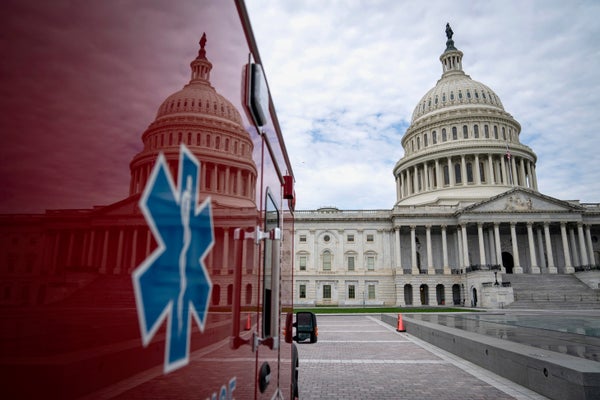

The night of September 11th, President George W. Bush addressed the nation.
[CLIP: “Terrorist attacks can shake the foundations of our biggest buildings, but they cannot touch the foundation of America.”]
The next day, Senate Majority Leader Tom Daschle, a Democrat, said Congress stood united behind the president in condemning the attacks.
On supporting science journalism
If you're enjoying this article, consider supporting our award-winning journalism by subscribing. By purchasing a subscription you are helping to ensure the future of impactful stories about the discoveries and ideas shaping our world today.
[CLIP: “The world should know the members of both parties, in both houses, stand united in this.”]
“There was a lot of interparty unity. The messages the public was receiving were not politicized. There was a moment in which that could have happened around COVID. And to my surprise, it didn’t.”
Skyler Cranmer is a political scientist at the Ohio State University. His team analyzed tens of thousands of tweets sent out by members of Congress. The idea was to determine how and when COVID-19 became a politically divided issue.
Cranmer says the split happened quickly. From mid-January to the end of March, Democrats sent nearly twice as many tweets about COVID-19 as did Republicans. And the two parties spoke about the virus differently. Democrats frequently used the words “health,” “testing” and “leave,” as in sick leave. Republicans tended to favor words like “together,” “China” and “business.”
The findings are in the journal Science Advances. [Jon Green et al., Elusive consensus: Polarization in elite communication on the COVID-19 pandemic]
Cranmer says this division among political elites has serious consequences: it fractures the response of everyday Americans to the threat. If instead both parties had been united, he says ...
“The cues that would be sent to individuals would have led to more consistent behavior changes among the public—and probably slow the spread of disease and probably save lives.”
As Anthony Fauci said on a June 25 Facebook Live event with the Sacramento Press Club and CapRadio ...
[CLIP: “It should not be a political issue. It is purely a public health issue. Forget the politics. Look at the data.”]
—Christopher Intagliata
[The above text is a transcript of this podcast.]
