
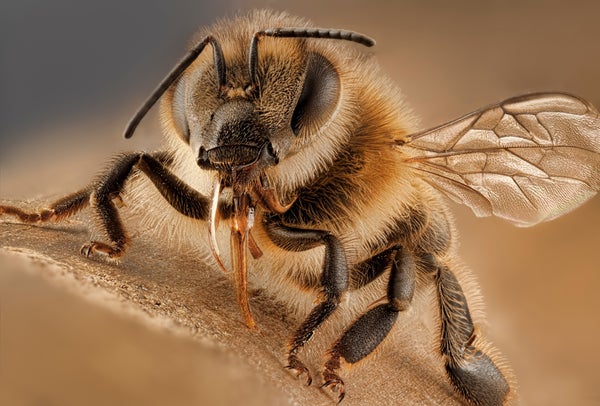

If there’s one thing we know about viruses, it’s that they love to spread. The novel coronavirus is happy to use us humans as its host. Other viruses fancy honeybees. But like us, bees fight back.
In the case of one particular virus, called Israeli acute paralysis virus, a study shows that honeybees actually use a form of social distancing to prevent transmitting the infection within their own colony. Of course, not to be outdone, the virus manipulates the bees in a way that spreads the infection to the colony next door. The study is in the Proceedings of the National Academy of Sciences. [Amy C. Geffre et al., Honey bee virus causes context-dependent changes in host social behavior]
Honeybees live in large communities that contain tens of thousands of related individuals in close quarters. So researchers got to wondering, How can bees keep infections from spreading like wildfire?
On supporting science journalism
If you're enjoying this article, consider supporting our award-winning journalism by subscribing. By purchasing a subscription you are helping to ensure the future of impactful stories about the discoveries and ideas shaping our world today.
While a graduate student at the University of Illinois at [Urbana-Champaign], Tim Gernat developed an automated system for tracking the behavior of thousands of bees. And he watched what happened when he introduced infected bees into the hive.
Entomologist Adam Dolezal, who worked with Gernat, describes what they saw.
“We found in this study that within their own colony context, when they are interacting with their nest mates—usually their sisters—infected bees experience fewer contact behaviors—fewer mouth-to-mouth feeding contacts—than bees who are not infected.”
The researchers also saw the same sort of social avoidance when, instead of infecting the bees with a virus, they artificially activated the bees’ immune system. So the behavior isn’t driven by the virus but by the bees’ own immune response—which Dolezal says makes sense. If honeybees are going to protect their colony and their queen from disease, sick bees need to keep their feelers to themselves.
“They have to. They live in these really large colonies, where everybody’s touching each other all the time; they’re all closely related. I joke that honeybees have been doing social distancing for millions of years.”
At the same time, bees are under no pressure to keep infections from spreading to other colonies. And that’s where the virus gains the upper hand. Amy Geffre, who worked on the project as a graduate student, found that the guard bees from other colonies were actually less aggressive toward incoming infected bees than they were to uninfected bees. As a result ...
“The infected bees are accepted into the colony at about twice the rate of control bees or immunostimulated bees.”
The virus, it seems, alters the chemicals that bees use to communicate who they are and where they’re from.
“And so we think that one way that the virus could be gaining entry to these other colonies is by changing the bees’ physiology in a way to make it more acceptable to other colonies’ guard bees.”
That’s bad news for beekeepers, who tend to keep tens or even hundreds of hives right next to one another.
“It’s a really ripe situation for bees to be able to move between colonies relatively easily and bring pathogens and parasites along with them.”
Seems ya gotta carefully mind your beeswax—and keep kept colonies healthily socially distanced.
—Karen Hopkin
[The above text is a transcript of this podcast.]
