

A recent analysis predicts that 40 percent of the world’s insect species could go extinct within the next few decades. The highest death tolls could be among butterflies, moths, bees and dung beetles.
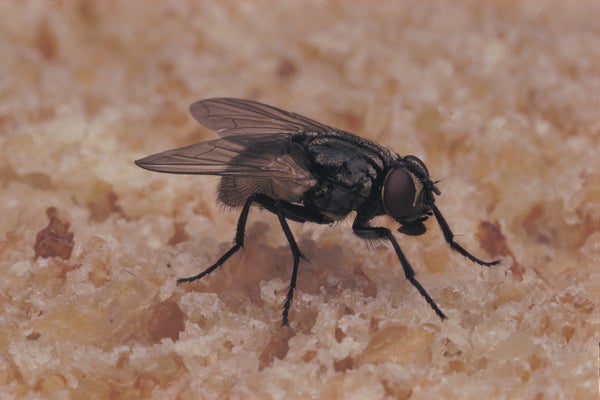
Conspicuously absent from that list are houseflies. Because they may actually do better in a hotter world. "Under a warming scenario you'd have a larger fly population which is able to hang around for a longer period of time." Amy Greer, an epidemiologist and mathematical modeler at the University of Guelph in Ontario.
Plus, she says, flies are also more active when it's warm. Meaning more chances to land on your picnic dips.
On supporting science journalism
If you're enjoying this article, consider supporting our award-winning journalism by subscribing. By purchasing a subscription you are helping to ensure the future of impactful stories about the discoveries and ideas shaping our world today.
Greer’s student Melanie Cousins, now a doctoral candidate at the University of Waterloo, explains the effect on us: "With this increase in fly population and fly activity, this may lead to more transmission of Campylobacter."
The common foodborne illness, like the flies, fluctuates with the seasons. "So with warmer temperatures Campylobacter will be able to replicate more efficiently."
Cousins modeled both the insect and bacterial trends under different global warming scenarios. And found that the uptick in fly populationnumbers did not matter much. But if warming truly does increase fly activity, then Campylobacter cases in the Ontario, Canada, area could more than double with a moderate 4 degrees Fahrenheit rise by 2080. The results are in the journal Royal Society Open Science. [Melanie Cousins et al., Modelling the transmission dynamics of Campylobacter in Ontario, Canada, assuming house flies, Musca domestica, are a mechanical vector of disease transmission]
These conclusions come with many caveats. The data is generated by a mathematical model, saying this is at least in theory possible. But it does not take into account a possible increase in fly predators, for example. And the researchers haven't actually tested flies landing on food to see if they're dropping off bacteria. And while it has been shown in past studies that flies can carry Campylobacter, it's unclear whether warming temperatures might affect their ability to do so.
Still, the researchers themselves are taking precautions. "I am a little more paranoid about it personally." "I bought one of those fly screens for picnics to go over the bowls."
—Christopher Intagliata
[The above text is a transcript of this podcast.]

