

One of the consequences of a warming world is that high mountain habitats, which used to be too chilly for trees, are heating up. "There is now newly available real estate above what we call tree line—the sort of literal line in the sand above which trees can't grow because it's too cold. But now it's not."
Brian Smithers is an ecologist at U.C. Davis. He compares this slow-moving migration to land-grabs back in pioneer times. "You know, they fired the guns and all the settlers made a mad dash to claim their stake. It's that, but if everybody were crawling on their bellies or something like that instead."
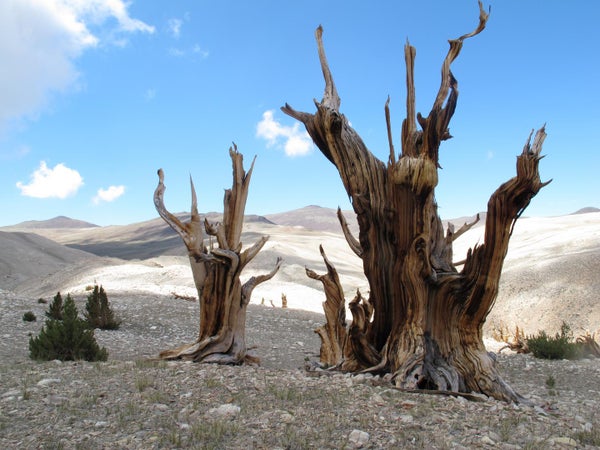
Smithers is studying this upslope race among bristlecone pines. These trees can live for more than 5,000 years—making them the oldest individual organisms on Earth. Many of them eke out a living in dry, rocky soils, on windblown ridgelines around 11,000 feet, in eastern California and Nevada. "They look like the worst bonsai tree imaginable. They just look gnarled and twisted, something that looks like it's taken a beating for 5,000 years and still living."
On supporting science journalism
If you're enjoying this article, consider supporting our award-winning journalism by subscribing. By purchasing a subscription you are helping to ensure the future of impactful stories about the discoveries and ideas shaping our world today.
So, as tree line rises, these giant bonsais are following. But Smithers says the ancient trees now have a competitor—a species called limber pines. The limbers are passing the bristlecones at tree line, sprouting seedlings in that fresh real estate upslope more quickly. ‘Quickly’ being a relative term. "It's the tortoise and the slightly faster tortoise." Smithers documents the race in the journal Global Change Biology. [Brian V. Smithers et al., Leap-frog in slow-motion: divergent responses of tree species and life stages to climatic warming in Great Basin sub-alpine forests]
The leapfrogging limber pines could put bristlecones in a bind, hemmed in by competing seedlings upslope, and hotter temperatures downslope. And that, Smithers says, would have long-lasting consequences. "You know, we talk about the effects of climate change happening on scales of 100 years. What's going to happen by 2100. But in 5,000 years someone will be able to go to this stand and say, oh it looks like this because people made climate change happen 5,000 years ago. It just changes the scale, when we talk about the effects of climate change." Assuming, that is, we stick around long enough to notice.
—Christopher Intagliata
[The above text is a transcript of this podcast.]
