

Human parents usually have one or sometimes two offspring at a time, and when babies get delivered we pour all our energy into child rearing. But other animals raise lots of babies at once. And the weaker individuals can be at a big disadvantage. If there's not enough food, for example, a mother bird might offer more to those chicks who are more likely to survive. Nature's a rough place.
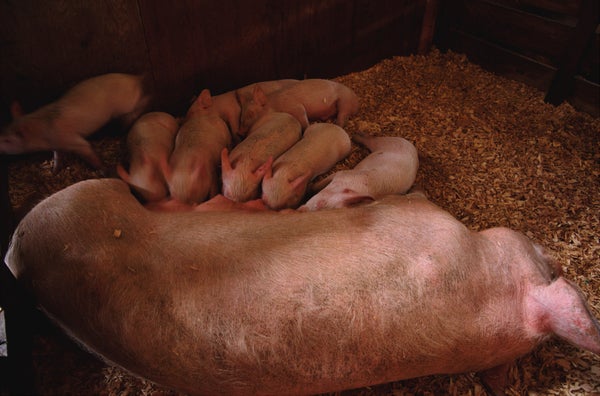
But mammals like pigs can't selectively provision their offspring the way birds do, because all the babies nurse at the same time. And yet the strongest piglets still seem to have an edge. One hypothesis goes that the weaklings might not have sufficient energy to stimulate the mammary gland while they suckle, so they eventually starve from a lack of nutrition.
But it turns out that vigorous stimulation of one mammary gland can increase blood flow in neighboring glands. So if a weakling was canny enough to position himself next to one of his strongest siblings, he might get more milk than positioned elsewhere.
On supporting science journalism
If you're enjoying this article, consider supporting our award-winning journalism by subscribing. By purchasing a subscription you are helping to ensure the future of impactful stories about the discoveries and ideas shaping our world today.
"I got this idea during observations of piglets, of course, because I had a feeling that weaklings are doing better in the company of [the] strongest siblings."
Biologist Janko Skok from Slovenia's University of Maribor.
To see if his hunch was right, Skok observed 18 litters, including 150 piglets. Twenty-three of them were classified as weaklings, which meant they weighed less than one kilogram at birth or they died before weaning. Then he looked to see what differentiated the weaklings that survived from those that died.
And indeed, those weaklings that survived were more likely to nurse next to their strongest brothers and sisters. "Weaklings, which are limited in terms of mammary gland stimulation, actually take advantage of strong stimulation implemented by their heavier siblings, who in turn do not suffer any costs from this activity."
The research were published in the journal Behavioural Processes. [Janko Skok, Being a weakling and surviving: Keep the fittest siblings close-by when eating.]
Skok says that pig breeders commonly sort piglets into different weight classes, so the heaviest babies nurse together with one mother while a different mother raises the weaker babies. But his results might mean that more piglets could survive if breeders instead mixed piglets of different sizes, so that the smaller ones could take advantage of their larger counterparts.
What this finding does not explain is why my younger brother, who as a kid always and failed to steal my dessert, is now stronger than I am.
—Jason G. Goldman
[The above text is a transcript of this podcast.]
