
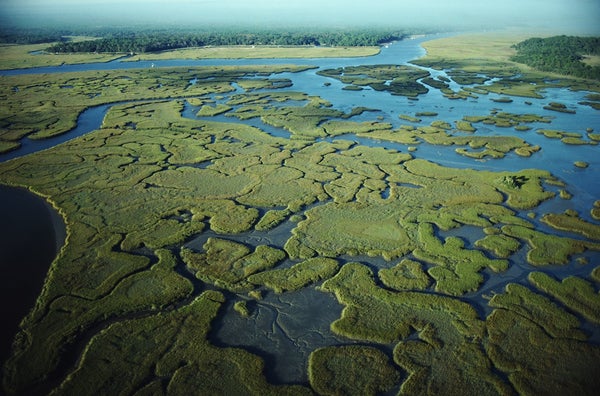

As Houston begins recovery efforts from Hurricane Harvey, a new storm threat—Hurricane Irma—is barreling west towards the Caribbean and Florida. We have few defenses against hurricanes' lashing rains and wind and storm surge—but nature does provide one.
"Wetlands act in two ways to reduce the impacts of storms. They reduce storm surge by acting as a wall or a barrier and they act as a sponge by soaking up the waters that come down via rainfall."
Michael Beck is a coastal scientist at The Nature Conservancy and the University of California Santa Cruz. He says as we've paved over swampy coastlines, we've changed how storm waters flow. Or, for an analogy a little closer to home:
On supporting science journalism
If you're enjoying this article, consider supporting our award-winning journalism by subscribing. By purchasing a subscription you are helping to ensure the future of impactful stories about the discoveries and ideas shaping our world today.
"Rain falls on your driveway, it's going to run straight out into the street. Rain falls in your garden it's going to soak into the ground. When you've done that at the scale of whole watersheds, there's nowhere for that water to go when it rains.”
But some wetlands do remain. Beck and his colleagues teamed up with the insurance industry, and, using the industry's risk assessment models, asked: how much more damage would Hurricane Sandy have delivered if all the eastern seaboard's wetlands were gone? And they found that marshy coastlines saved some $625 million dollars in direct flood damages—or about one percent of Sandy's total cost.
The researchers also battered Ocean County, New Jersey, with thousands of hypothetical storms using flood models. And found that wetlands cut flood damages there by 16 percent, compared to areas of the county where wetlands are gone. The study is in the journal Scientific Reports. [Siddharth Narayan et al., The Value of Coastal Wetlands for Flood Damage Reduction in the Northeastern USA]
Next, it's up to local governments and the insurance industry to take notice. "Certainly we hope that we will continue to conserve wetlands in part for their intrinsic beauty and the importance of nature." But he says by putting a price-tag on the economic benefit of wetlands it might change the conversation…about conservation.
—Christopher Intagliata
[The above text is a transcript of this podcast.]
