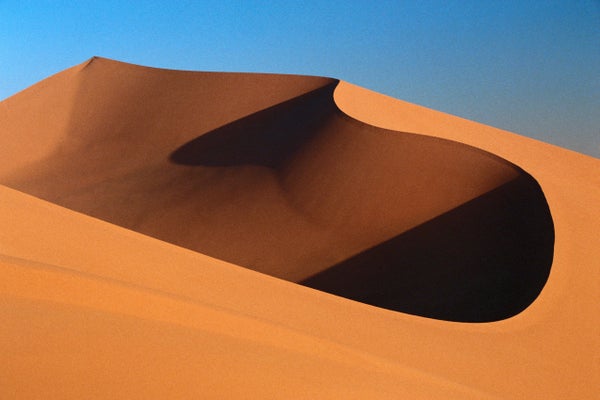
What Makes Sand Dunes Sing

Engineers at Caltech discovered that for sand dunes to produce sound they need a dry layer on top that amplifies internal frequencies during sand movement. Christopher Intagliata reports

Corbis (MARS)

Illustration of a Bohr atom model spinning around the words Science Quickly with various science and medicine related icons around the text

Join Our Community of Science Lovers!

<> The sound of supernatural spirits talking? Well, no. But that’s what it sounded like to Marco Polo as he travelled through China's Lop Desert in the 13th century. He also described the sound as “a variety of musical instruments.” And in reality, the mysterious noises are the product of what could be considered to be an unusual sort of instrument—the desert’s sand dunes. <

"And it's a sound that's very similar to kind of the tones you'd get on a cello." Melany Hunt, a mechanical engineer at Caltech. The dunes sing when sand avalanches down the side, "which would then be somewhat equivalent to using the bow on the strings of the cello."

Hunt and her colleagues recorded the sounds produced closer to home, by California's Kelso and Eureka Dunes. They used four dozen geophones—microphones you stick in sand. And they mapped the dunes' structure with ground penetrating radar. Turns out, dunes that sing are built differently from silent dunes—they’re topped with an even layer of dry sand—about five feet thick—on top of all the damp sand below. And that layer of dry sand is like the body of an instrument—it traps and amplifies certain frequencies more than others. "And so really the size of the instrument is really going to set the range of frequencies that you get. And that's the same thing with this dune." 


On supporting science journalism

If you're enjoying this article, consider supporting our award-winning journalism by subscribing. By purchasing a subscription you are helping to ensure the future of impactful stories about the discoveries and ideas shaping our world today.


When sand avalanches, it shoots off sound waves of various frequencies. Those waves travel through the dry sand, hit the wet layer, bounce back, hit the air on top of the dune, bounce back, and so on. As that happens, a lot of the frequencies cancel out and dissipate. But certain waves have the goldilocks frequency, around 80 Hertz. As they travel back and forth, they amplify, creating that booming sound. The study is in the journal Physics of Fluids. [N. M. Vriend et al, Linear and nonlinear wave propagation in booming sand dunes]

The bad news? Since the 'instrument' requires a uniform, thick layer of dry sand, Hunt says the dunes tend to fall quiet in the cooler, wetter months. Meaning you'll have to brave summer heat if you want to hear the dunes when they're really in tune.

—Christopher Intagliata

[The above text is a transcript of this podcast.]

It’s Time to Stand Up for Science

If you enjoyed this article, I’d like to ask for your support. Scientific American has served as an advocate for science and industry for 180 years, and right now may be the most critical moment in that two-century history.

I’ve been a Scientific American subscriber since I was 12 years old, and it helped shape the way I look at the world. SciAm always educates and delights me, and inspires a sense of awe for our vast, beautiful universe. I hope it does that for you, too.

If you subscribe to Scientific American, you help ensure that our coverage is centered on meaningful research and discovery; that we have the resources to report on the decisions that threaten labs across the U.S.; and that we support both budding and working scientists at a time when the value of science itself too often goes unrecognized.

In return, you get essential news, captivating podcasts, brilliant infographics, can't-miss newsletters, must-watch videos, challenging games, and the science world's best writing and reporting. You can even gift someone a subscription.

There has never been a more important time for us to stand up and show why science matters. I hope you’ll support us in that mission.

Thank you,

David M. Ewalt, Editor in Chief, Scientific American

Subscribe