
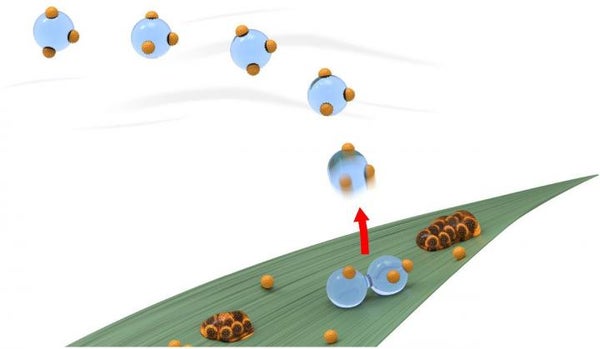

Humans can spread disease by sneezing. But less well known is the wheat plant's ability to do something strangely similar—from its leaves.
"It's basically analogous to a human sneeze in terms of, you have a very fast and sudden expulsion of droplets that contain the disease or pathogen inside of it, and they get thrown away from the surface."
Jonathan Boreyko, a mechanical engineer at Virginia Tech. He and his team were studying the ability of wheat plants to expel spores of a common pathogen, the wheat rust fungus, from their leaves via this unusual mechanism. So they inoculated wheat plants with the disease, created dew on the plants' leaves and then studied the ensuing action with high-speed microscopy.
On supporting science journalism
If you're enjoying this article, consider supporting our award-winning journalism by subscribing. By purchasing a subscription you are helping to ensure the future of impactful stories about the discoveries and ideas shaping our world today.
Here’s what they saw. The leaves are extremely hydrophobic, meaning water beads up to minimize contact with the surface. And when two or more drops touch, energy gets released in the form of a catapulting action, which "sneezes" the droplets into the air several millimeters above the leaf surface. The droplets can then be picked up by light breezes or simply fall and spread to other plants. The process is surprisingly effective at launching spores: the researchers figure each leaf can launch 100 spores per hour during a morning dew.
The results—and photos of the jumping drops—are in the Journal of the Royal Society Interface. Saurabh Nath et al., ‘Sneezing’ plants: pathogen transport via jumping-droplet condensation
Next, Boreyko and his team want to see what happens if they spray stuff on the leaves that changes the way dew forms. "If we change the wettability of the leaves so they're no longer super hydrophobic, now the dew drops will be unable to jump when they grow. They'll just sort of cling to the leaf surface and not be jumping anymore."
Such treatment could perhaps put a stop to wheat sneezes and slow down the transmission of disease.
—Christopher Intagliata
[The above text is a transcript of this podcast.]
