

You are what you eat, the old expression goes. But it leaves out one crucial detail. "We don't dine alone. We dine with trillions of friends." Jeff Gordon, a microbiologist at Washington University in Saint Louis. "And they are partners in consuming these meals and ingredients."
Those friends—they're microbes in our guts. They break down dinner, including otherwise indigestible stuff, and pass the leftovers on to more microbes. Creating a complex food web inside us.
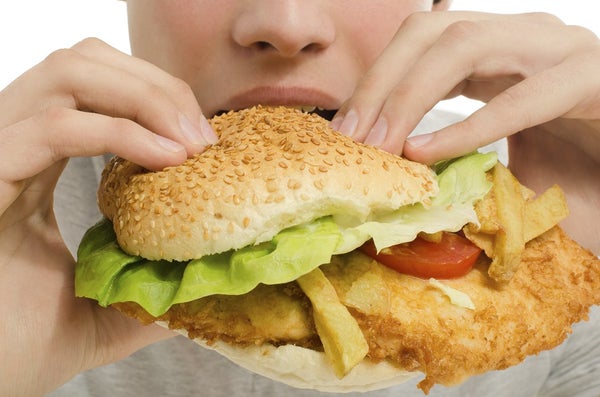
But that microbial garden is a lot more diverse in people who eat a calorie-restricted, veggie-rich diet. The typical American diet on the other hand—breads, meat, cheese, not a lot of veggies—doesn't raise up near as diverse a crop of microbes.
On supporting science journalism
If you're enjoying this article, consider supporting our award-winning journalism by subscribing. By purchasing a subscription you are helping to ensure the future of impactful stories about the discoveries and ideas shaping our world today.
And microbial diversity matters. Because in a mouse model, Gordon's team found that, if you give up the American diet, in favor of a healthier one with lots of veggies—the "Americanized" gut bacteria, being less diverse, aren't primed to respond. They're not great at regrouping, to accommodate all the nutrients in kale and broccoli and so on. The study is in the journal Cell Host & Microbe. [Nicholas W. Griffin et al., Prior Dietary Practices and Connections to a Human Gut Microbial Metacommunity Alter Responses to Diet Interventions]
All this isn't to say you shouldn't try to eat healthier. Because it's not clear how this microbial efficiency translates into human health. Or to what extent you might be able to pick up beneficial microbes from those around you, as they demonstrated mice can, in this study. But Gordon's colleague Nick Griffin had this prediction: "It's entirely possible that in the future we'll more and more recognize a need to reinstall absent populations of bacteria in people as they're looking to change their diet for benefits to health."
Until then—next time you're about to fertilize your microbial flora with a patty melt—you might just wanna do a gut check first.
—Christopher Intagliata
[The above text is a transcript of this podcast.]
