
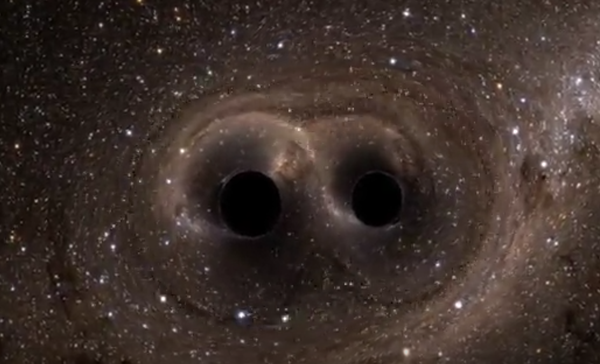

Last year, astronomers observed two neutron stars collide—a crash transmitted in gravitational waves to detectors here on Earth. Represented in sound, you can hear a small upwards sweep in frequency, in the data, if you listen closely.
<
Several seconds later, the first waves of electromagnetic radiation arrived here on Earth - the first time a collision has been detected by both light and gravitational waves. And it's in studying the electromagnetic echoes of the collision that astrophysicists have gotten a far better glimpse of what really happened after those binary neutron stars merged, 130 million light-years away.
On supporting science journalism
If you're enjoying this article, consider supporting our award-winning journalism by subscribing. By purchasing a subscription you are helping to ensure the future of impactful stories about the discoveries and ideas shaping our world today.
"Oh yeah, absolutely, so it gives us an understanding of basically all the nitty gritty of what's going on after the merger takes place." Kunal Mooley, an astrophysicist at Caltech.
First, he says, the stars collided <
"It cannot eat all of it, so some bit of it basically escapes." Those escaping leftovers spewed outward into space, as a powerful jet. But along the way, Mooley says, the jet appears to have interacted with that cloud of neutron-rich material, blowing up a sort of cocoon within the debris floating around the collision. Until finally, the jet burst out and slammed into interstellar space… releasing yet more radiation we could detect here on Earth.
The full play by play is in the journal Nature. [K. P. Mooley et al., Superluminal motion of a relativistic jet in the neutron-star merger GW170817]
In this case, Mooley says, we were lucky to spot the event—the narrow jet was pointed close to Earth. But these collisions could be happening all the time, just that their jets point in directions hard to detect from Earth. But maybe, he says, astronomers can now look for those 'cocoons' as an alternate way to study these colossal bits of cosmic wreckage.
And while gravitational waves are exciting, "there's a lot more to be learned through electromagnetic waves and gravitational waves than that is to be learned through gravitational waves alone." When the LIGO gravitational wave detector fires up, early next year, he says, he'll be watching, waiting, perhaps, for his next study subject.
—Christopher Intagliata
[The above text is a transcript of this podcast.]
