
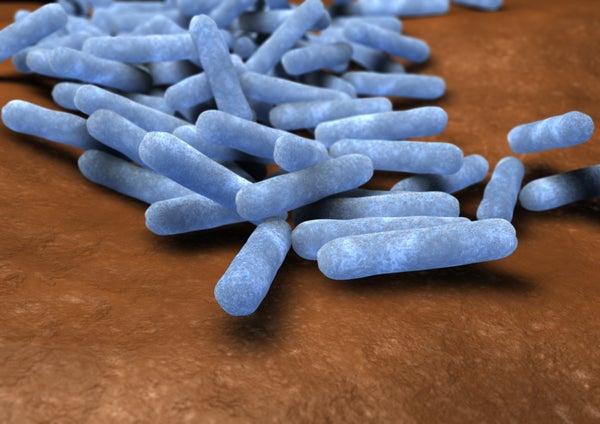

A humid bathroom is the perfect habitat for mold. But there are ways to avoid it. "We can just open the window and let some fresh air in!" Not so easy on a space station though, as astrobiologist Petra Schwendner of the University of Edinburgh explains.
"It has been seen on the international space station or on the MIR that these microorganisms can accumulate. I've seen pictures where you could see this corrosion caused by bacteria or an accumulation of fungus behind wet towels."
So as we set our sights on Mars, what might grow in the spacecraft—essentially a human-scale petri dish—during the year-and-a-half-long flight?
On supporting science journalism
If you're enjoying this article, consider supporting our award-winning journalism by subscribing. By purchasing a subscription you are helping to ensure the future of impactful stories about the discoveries and ideas shaping our world today.
The Mars500 habitat in Moscow simulated that trip, with six crew members confined inside. And Schwendner and her team tested microbial samples of the habitat over time. They found what you might expect: a lot of human-related bacteria and fungi, mostly at levels deemed safe for life in space. But they also noticed a decline in microbial diversity over time—which could indicate a less-than-healthy microbial community that’s potentially more prone to takeover by hostile bacteria.
"Seeing this decrease is for us an important point or proof that continuous monitoring is an important fact and is really required for being able to maintain a healthy environment." The study is in the journal Microbiome. [Petra Schwendner et al., Preparing for the crewed Mars journey: microbiota dynamics in the confined Mars500 habitat during simulated Mars flight and landing]
When we do rocket to the Red Planet, it'll be impossible to keep our spacecraft completely sterile. Humans are leaky animals. The real question might be how we'll keep our many microbes…from colonizing Mars.
—Christopher Intagliata
[The above text is a transcript of this podcast.]
