

Rachel Feltman: For Scientific American’s Science Quickly, I’m Rachel Feltman.
In 2024, which is the most recent year the Centers for Disease Control and Prevention have released data for, Black women faced a maternal mortality rate of 44.8 deaths per 100,000 live births. That means they were more than three times as likely to die during childbirth than white women were.
But the Black maternal mortality crisis is just one part of a much larger problem. Black women also face disproportionately high rates of fibroids throughout their lives. They’re also more likely to have endometriosis go undiagnosed and more likely to die from endometrial cancer.
On supporting science journalism
If you're enjoying this article, consider supporting our award-winning journalism by subscribing. By purchasing a subscription you are helping to ensure the future of impactful stories about the discoveries and ideas shaping our world today.
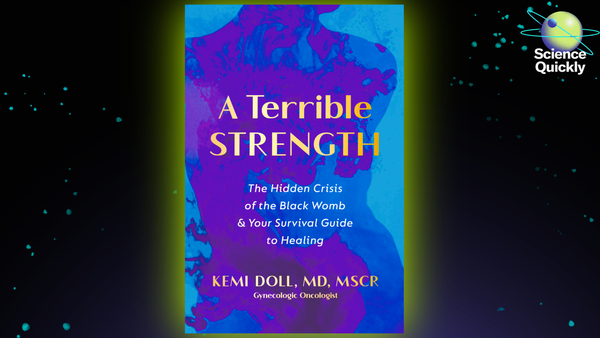
Today’s guest calls this the Black womb crisis. Dr. Kemi Doll is a professor in the University of Washington School of Medicine’s Department of Obstetrics and Gynecology and the director of the university’s Gynecologic Research and Cancer Equity Center. Her new book, A Terrible Strength, combines research data and personal stories to offer insight into this crisis and a way forward.
Thank you so much for coming on to chat with us today.
Kemi Doll: Thank you for having me.
Feltman: I think some of our listeners are, are probably familiar with the Black maternal mortality crisis, but your book broadens its scope to what you call the Black womb crisis. Can you tell me more about what that phrase encompasses and why that distinction is important?
Doll: Yes, I use that phrase very intentionally to encompass the entire what I think of as, like, the gynecologic life course, so, like, the womb from the time that you start your period and through and past the time that people go through menopause, because, as we know, we spend most of our lives not pregnant. And there are severe gynecologic conditions, up to and including cancer, that disproportionately affect Black women. And what I have found is that when I use the language of the womb, it kind of brings everybody into what we’re talking about and allows us to expand our imagination past just the maternal mortality crisis, to recognizing that the womb itself is actually—we’re having a lot of suffering, you know, from many diseases across the life course.
Feltman: Mm. So tell me a little bit about what brought you to writing this book.
Doll: I am a clinically trained gynecologic oncologist, and I’m also a health-equity scientist, and so my research really focused on the question of why Black women had such a higher mortality rate after endometrial cancer diagnosis in this country. And I like to say that I was agnostic to method; I’m very focused on the problem, and I’ll use any method to get to a solution. And one of the things that we found early on is that endometrial cancer, for a lot of Black women, is just the end of a lifetime of suffering from fibroids and endometriosis and heavy bleeding and that even though, from a medical and biological standpoint, we think of cancer as this other entity and we’re kind of over in a different category, for the actual Black woman going through the disease, she thinks of it as yet another womb condition she’s dealing with.
And so what brought me to write the book was recognizing that we’re not going to bridge the gap of understanding about endometrial cancer and we’re certainly not going to start to intervene on the issues with delayed diagnosis and incomplete treatment and the things that plague Black women unless we speak to the experience Black women have over their entire lives with their womb. And so this book is really serving to create a new narrative where we unite those perspectives and frankly that we show Black women that from—physicians and scientists can also speak to them in a holistic manner that takes into account all of their life experiences with regard to their womb.
Feltman: Can you tell me more about what we might miss when we just focus on the data in trying to solve problems like this?
Doll: Sure, so a great example is how we diagnose endometrial cancer. So when I was in training and coming up, I learned that the way that we diagnose endometrial cancer is that when a woman has postmenopausal bleeding, she comes to the doctor, we do an ultrasound to evaluate the thickness of what we call the endometrial lining, or the endometrial echo, and if that is over a certain threshold, then her risk is higher and we do a biopsy to rule in or rule out endometrial cancer.
So that sounds very straightforward, but one of the early things that we saw was how much that algorithm really did not take Black women’s experiences into account. So for example, Black women have higher rates of irregular cycles, fibroids and long challenges with heavy menstrual bleeding during the reproductive years. The idea that they’re running to the doctor after a few drops of postmenopausal bleeding is not a reality, but that’s what we assumed. We also, when we looked at the data with regard to ultrasound and its accuracy of using this thickness threshold to diagnose endometrial cancer, it doesn’t work as accurately in Black women because of the prevalence of not just fibroids but larger fibroids and the location that they are in the uterus.
And so without a perspective on understanding the differential experience of Black women in terms of their gynecologic health, as well as a scientific perspective of understanding who were included in these ultrasound trials or not, we had an entire paradigm that disproportionately led to more false negatives for Black women, which contributes to delayed diagnosis. So I’m very happy that now in 2026, [the American College of Obstetricians and Gynecologists] just updated the guidelines to change how we diagnose endometrial cancer and correct, you know, this racial disparity.
But that’s a great example of how critical it is that we consider race because of the differential experience that Black women have in not only the conditions that they deal with but in how they seek care.
Feltman: How have these issues evolved during your time as a clinician?
Doll: I would say that now more than ever I see a much greater interest outside of medical circles, outside of clinical circles, in the lay public to talk about gynecologic issues. I mean, people are talking about endometriosis, and they’re talking about their perimenopausal symptoms and all of that stuff, and that has changed significantly from when I started practice.
I think where the gap still exists is that right now a lot of women, and especially women of color and Black women, are really looking for solutions, and they’re looking for who can they trust to answer these questions. And there’s still a gap there that I see between us as clinicians and researchers being able to speak to the science of what we know, especially amid the noise of a lot of misinformation and wellness influencers and things like that.
And so it’s another reason why I wrote my book, because some of it was I just wanna give women information and I wanna show them, “Hey, these are the treatments options available, etcetera,” but also, if you understand the gynecologic organs better, if you understand the physiology of these conditions better, you’re better equipped to also judge, engage yourself what makes sense and what doesn’t in the online milieu.
So I think a big change is just, frankly, the conversation has moved out of the doctor’s office. And it’s a really good thing because we’re talking about it more and women are advocating for themselves more, but we also need to catch up in terms of making sure that we are sharing evidence-based information and we’re part of the conversation. I think that’s the biggest change I’ve seen in gynecology and gynecologic cancer as a field since I started practicing.
Feltman: Did you come across anything surprising in the course of researching and, and writing the book?
Doll: I think one thing I came across—and I recognize the book has a lot of science and data in it, and then it has a lot of storytelling, you know, to connect with people in different ways—I was really amazed at all of the women that I interviewed, where we went really in depth with what was going on with them and with different conditions, heavy bleeding, endometriosis, fibroids, endometrial cancer, how consistently the stories of negative experiences with gynecologic care was.
I was already aware that Black women had difficult experiences when seeking reproductive health care, right, so when seeking, like, pregnancy care. I didn’t know that my own story of my very first gynecology visit, which was quite violent and very negative, would be something I would hear echoed over and over again as I talked to these women. And it made me even more passionate about why we as a field need to speak to this community and connect with them differently because I think that we are only scratching the surface of some of the negative experiences that Black women are having when just seeking something like a Pap smear, so basic, basic gynecologic care.
And so it surprised me ’cause I didn’t plan to really speak to clinicians in this book, but I ended up adding sections about how we as clinicians need to be aware and approach our patients because I just kept hearing these stories over and over. And it’s kind of one of those things where you can understand how it happened, but there’s a new level of appreciation of the negative impact on each individual woman. That was the most surprising thing to me.
Feltman: How do you hope to see things change in the next five, 10, 20 years? You know, what needs to change, and what are you optimistic about?
Doll: This is happening already, and I wanna see more of it. Endometrial cancer is, like, one of the No. 1 rising cancers in the United States. So most cancers are stable or declining—not endometrial cancer, where you can see more cases every year, the mortality rate is going up. And I want to see our public-health infrastructure and our cancer-funding and cancer-advocacy infrastructures shift to acknowledge that reality. As more and more of us age and the hysterectomy rate is declining rapidly, we’re going to continue to see these rising [numbers] of cases.
And so the thing about endometrial cancer is that it’s very interesting scientifically in terms of the different types and what we’re doing, but we’re also in a place where there’s increasingly successful treatments. Every year we get trials that are improving survival, we have an incredible ability to detect it early, and we’re gonna have more and more people affected. So my public-health brain gets very excited because this is, like, the perfect combination of being able to show that when we put resources and dollars and education and intervention around a problem, we can really turn the tide. So I want to see more public conversations about this cancer that’s the most common gynecologic cancer in the U.S. It affects one in 32 women; that will be one in 17 by 2050. And I think that we can do it, and I think that we’re seeing some of that momentum now.
The other thing that I want to see in general is that—and I think this is also happening, but we have more room—increasing the [National Institutes of Health] budget for women’s health research, increasing the number of ob-gyns that we have in the country, expanding the national imagination of women’s health beyond pregnancy and contraception and STDs to what we actually deal with, which are these very common chronic conditions that are underfunded and need more research funding but also need more clinical care funding, which I don’t think we talk about as much. Yes, we need more research funding, but we need more clinical care funding. We need more providers. We need more access.
So this is the feminist in me, but I do think once women decide, like, “We not doing this anymore. [Laughs.] Like, we demand a better quality. We demand something better,” I do think we see the needle move. And so I see more and more of that happening, and I hope to see more and more of that happening so that it doesn’t take four years to get an endometriosis diagnosis, so that we’re not missing endometrial cancers, so that we don’t have women with heavy bleeding who are walking around anemic, which is right now our norm.
I do think, with the greater conversation we’re having now around gynecology and menopause, etcetera, I think there’s more of a realization that when there are attacks on reproductive freedoms—so when we are getting more and more restrictions around abortion and even contraception and things like that—there is a measurable and clear impact on the quality and access to all of gynecologic care.
We kind of live in this flattened narrative where, like, “birth control,” for example, is used to describe hundreds of medications. Some of those medications are actually formulated to treat endometriosis. They’re formulated to help people with their fibroids. But when they’re all under the same umbrella and then birth control is demonized, we’re gonna have a huge problem, right, with treating these conditions.
It’s part of the reason why I am pretty passionate about expanding, like, the definition of when we say, like, “women’s health,” the definition of when we talk about that, because if we think about it to include more of these gynecologic conditions, as well as the gynecologic cancers, it changes the conversation when you start talking about limiting access to care.
I hope what I’ve done in the book is demonstrate how we as scientists and we as clinicians can actually shift that narrative without losing any scientific accuracy, you know, without losing any evidence. I think it’s very possible to do so, and then we’ll get the public more aligned with what we see, and I think that also improves advocacy and access.
Feltman: Thank you so much for coming on to talk about your book today. I really appreciate it.
Doll: Thank you so much for having me. This was great.
Feltman: That’s all for today’s episode. We’ll be back on Monday with our weekly science news roundup.
Science Quickly is produced by me, Rachel Feltman, along with Fonda Mwangi, Sushmita Pathak and Jeff DelViscio. This episode was edited by Alex Sugiura. Shayna Posses and Aaron Shattuck fact-check our show. Our theme music was composed by Dominic Smith. Subscribe to Scientific American for more up-to-date and in-depth science news.
For Scientific American, this is Rachel Feltman. Have a great weekend!
