
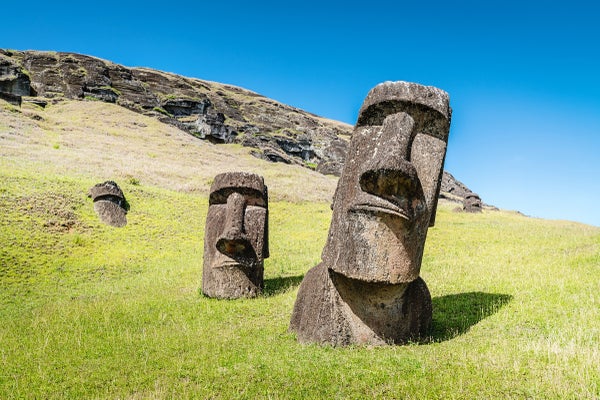

The statues on Easter Island are among the most mysterious objects made by humans. We still don’t know how they were moved, why they were placed at particular sites around the island and why they were made in the first place. Now researchers think they have at least some answers, because a new analysis finds that the statues are situated near sources of freshwater. The study appears in the journal PLOS ONE. [Robert J. DiNapoli et al., Rapa Nui (Easter Island) monument (ahu) locations explained by freshwater sources]
It’s believed that the residents of Rapa Nui—the Indigenous name for Easter Island—began constructing these carvings in the 13th century. The statues, called moai, which sit upon stone platforms called ahu, are the very definition of monumental. Most weigh between 20 and 30 tons. And of the 1,000 on the island, about 400 have been moved from the quarry where they originated and placed on ahu located elsewhere.
“But those ahu locations aren’t necessarily everywhere. They’re in some places and not in others. And the question we started to ask ourselves was, ‘Why do we find these ahu and moai some places on the landscape but not others?’”
On supporting science journalism
If you're enjoying this article, consider supporting our award-winning journalism by subscribing. By purchasing a subscription you are helping to ensure the future of impactful stories about the discoveries and ideas shaping our world today.
Carl Lipo, an anthropologist at Binghamton University in central New York. He says that most of these sculptures are found along the coast, but some are inland. And they’re not necessarily at obvious places.
“For example, we don’t find ahu and statues located on the tops of hills—places that we might expect to find them if these things were symbolic or representing ancestors, where you wanted to show off to everybody in he world, or the island itself, the fruits of your creation of these statues.”
So the statues are more than just towering talismans to be admired from afar. Indeed, Lipo and his colleagues noted that people spent most of their time living and working around these sites, which made the researchers think that the the statues might be located near a valuable resource.
“So the question was: What resource? Was it water, freshwater, marine resources or cultivation places? Which of those, or which combination of those, best explained the locations of ahu on the landscape?”
Their statistical analyses pointed toward potable water, which Lipo says made sense.
“Every single time we found a big source of freshwater, there would be a statue and an ahu. And we saw this over and over and over again. And places where we didn’t find freshwater, we didn’t find statues and ahu.”
Now, that doesn’t mean that the structures served as markers—like a sign saying “Get Your Water Here”—but rather that the community themselves were connected to those resources. And thus, their investment in statues was done around that resource.
“Because these are the locations that had the resources that they needed to survive.”
It seems that many of the massive sculptures are where they are for totally pragmatic reasons: “We’ll build here because here is where we want to be.”
—Karen Hopkin
[The above text is a transcript of this podcast.]
