
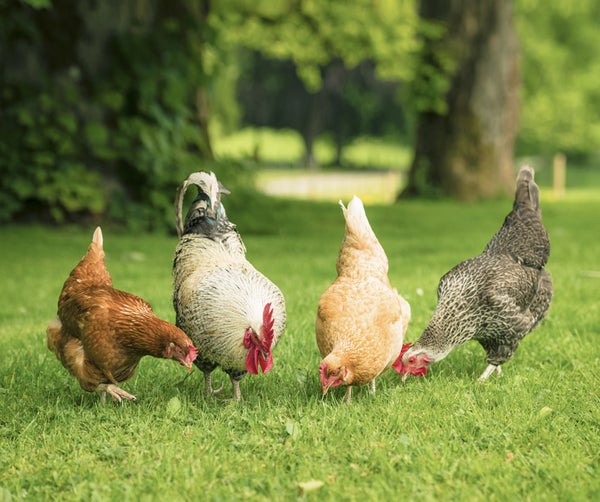

Why did the chicken cross the road? Well, that’s a philosophical pickle. But if you want to know why chickens don’t get cross at people—why they’re content being kept in their coops—science can help.
“Domestic species are interesting because their genetic makeup has changed dramatically as part of the process of going from wild to domestic.”
Liisa Loog, an evolutionary geneticist and anthropologist at the Universities of Oxford and Cambridge.
On supporting science journalism
If you're enjoying this article, consider supporting our award-winning journalism by subscribing. By purchasing a subscription you are helping to ensure the future of impactful stories about the discoveries and ideas shaping our world today.
“And indeed when people have compared modern domestic animals with their wild relatives they’ve identified genes that do show signs of strong recent selection. One such gene is thyroid stimulating hormone receptor, otherwise known as TSHR…in chickens, a variant of this gene that is widespread in modern populations has been shown to directly cause chickens to be less fearful of humans and also result in reduced aggression towards conspecifics.”
But when exactly did the selection for these traits—and therefore this variant—take place?
“It’s been suggested because of the potential usefulness of these traits in domestic setting that selection on this gene must have happened when chickens were first domesticated around 6,000 years ago in East Asia. But in an evolutionary timescale this is just a blink of an eye and we just don’t know and don’t have the resolution to tell when exactly between 6,000 years ago and now this selection happened, using data from only modern chicken populations…but with DNA from archaeological material we can follow what happened with a gene through time and in theory spot when changes in a population occur.”
Loog and her colleagues examined TSHR gene sequences in the ancient remains of about 60 chickens found in Europe “and estimated that selection at this TSHR locus happened only around 1,000 years ago, at medieval times. That is, 5,000 years after the initial domestication of chicken.
“Interestingly this time period coincides with a…substantial increase in chicken consumption known from the archaeological record. Historians suggest that a key driver behind these changes was the rising popularity and spread of Christian traditions, which discouraged and also on occasions even banned eating meat from four-legged animals.”
But fowl were fair game.
“What is really exciting about this new study is that for the first time we can directly link genetic changes in domestic animal with cultural shifts in human food preference. The findings appear in the journal Molecular Biology and Evolution. [Liisa Loog et al., Inferring allele frequency trajectories from ancient DNA indicates that selection on a chicken gene coincided with changes in medieval husbandry practices]
This kind of plucky study is not just for the birds. Loog says the team is collecting canine archaeological samples, so they can look at how man’s best friend got divvied up into so many different breeds. Their research will no doubt be dogged.
—Karen Hopkin
[The above text is a transcript of this podcast.]
