
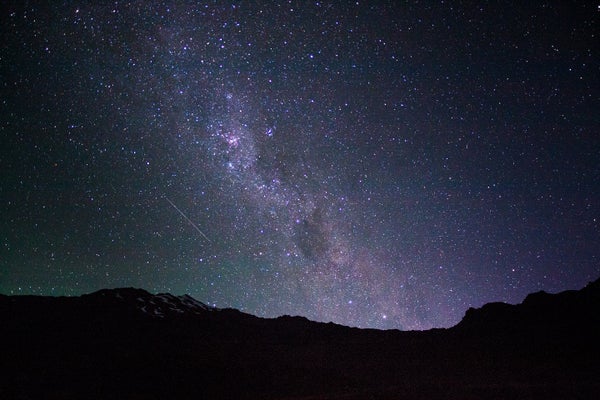

On March 11, 1437, Korean royal astronomers noticed something out of the ordinary in the night sky. "There was a brand new star they'd never seen before, between two of the well-known stars in the tail of Scorpius. That star was only seen for 14 days and then it disappeared and was never seen again."
Michael Shara, an astronomer at the American Museum of Natural History in New York. He’s spent more than two decades puzzling over this star that winked at astronomers nearly 600 years ago. "It's a many-sided jigsaw puzzle and I won't say we've filled in all the pieces, but at least I think we've got the corners and the boundaries pretty much in place now."
What he and his colleagues have determined is this: the "disappearing star" the Korean astronomers spotted was in fact a massive explosion produced by a special type of binary star system, known as a 'cataclysmic variable.'
On supporting science journalism
If you're enjoying this article, consider supporting our award-winning journalism by subscribing. By purchasing a subscription you are helping to ensure the future of impactful stories about the discoveries and ideas shaping our world today.
The system consists of two stars. One's a white dwarf—“the corpse of something that used to be a star in the distant past." And its companion is a hydrogen-rich star, pretty much like our sun.
"The white dwarf's gravity is so powerful it can suck hydrogen off of that companion. So in essence it's cannibalizing its companion hydrogen-rich star. That hydrogen flows into a ring around the white dwarf, and then every few months or few years the ring builds up, becomes more and more massive and collapses down onto the white dwarf. That gives rise to dwarf nova eruptions."
But every couple of hundred thousand years, those dwarf eruptions are punctuated by much bigger bangs, as more and more hydrogen builds up. "You blow up as a gigantic hydrogen bomb, that's a thermonuclear event. And that classical nova is what happened in 1437 to this star."
Shara's team located the cosmic remains of that huge explosion. And they were able to determine that the nova of 1437—and smaller dwarf nova eruptions photographed in that same square of sky in the 1930s and '40s—were actually hiccups of light from the same binary star…in different phases of its life cycle.
"And hence dwarf novae and old novae are the same things. Just like butterflies and caterpillars are the same things." The study is in the journal Nature. [M. M. Shara et al., Proper-motion age dating of the progeny of Nova Scorpii A.D. 1437]
Shara says 50 of these novalike fireworks explode every year in the Milky Way…illuminating the galaxy, and perhaps, our understanding of the evolution of stars.
—Christopher Intagliata
[The above text is a transcript of this podcast.]
