Humans can recognize each other by voice alone. I sound different from other 60-Second Science reporters, for example. In fact, lots of nonhuman animals, of all types, use voices to distinguish familiar individuals…including frogs, fish, lemurs, and penguins.
And that unique audio fingerprint extends to a sound you may have heard in the forest on occasion: <>...the drumming of a woodpecker.
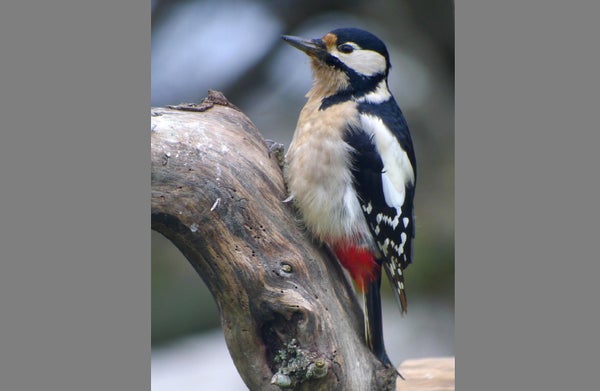
Researchers recorded multiple drum rolls, <> from 41 great spotted woodpeckers—colorful red, white and black birds—living in Polish forests. They then used audio software to analyze them.
On supporting science journalism
If you're enjoying this article, consider supporting our award-winning journalism by subscribing. By purchasing a subscription you are helping to ensure the future of impactful stories about the discoveries and ideas shaping our world today.
And they found that the length of the drumrolls, and the spacing between beats varied enough from bird to bird to tell the woodpeckers apart by drumming alone. The study is in the journal PLOS ONE. [Michał Budka et al., Vocal individuality in drumming in great spotted woodpecker—A biological perspective and implications for conservation]
The scientists say this fact might be useful to woodpeckers, in identifying each other. And to conservation biologists, trying to tease one bird from another in a recording, for example, to count individuals in a given area. The birds' head-banging could thus do away with that research headache.
—Christopher Intagliata
[The above text is a transcript of this podcast.]
Subscribe to Support Independent Journalism
Great science journalism requires human expertise, time, effort and creativity. And it costs money. That’s why I and the journalists here at Scientific American hope you’ll join our community.
When you subscribe, you are supporting staff and freelance journalists who are passionate about telling science stories that are true, important and compelling. Our editors and reporters are often experts in their fields, which means they understand the nuances of big discoveries and can untangle the breakthroughs from the hype. With a subscription, you are also supporting rigorous fact-checking to ensure the words we publish are precise and accurate. And you’re supporting original illustrations, graphics and photos that bring you closer to an advanced laboratory, an ice sheet in Antarctica or a space mission in orbit. You’re helping us craft other types of high-quality journalism as well: Our newsletters are carefully written, edited and curated by staffers you have or will come to know and love. Our Science Quickly podcast is based on original reporting, collaboration with editors and scientists and exacting production.
Subscriptions keep this engine running so we can continue to deliver thoughtful, rigorous and independent science journalism to you. In an era of viral misinformation, this work is crucial. If you value what we do, I hope you’ll consider joining us as a subscriber