
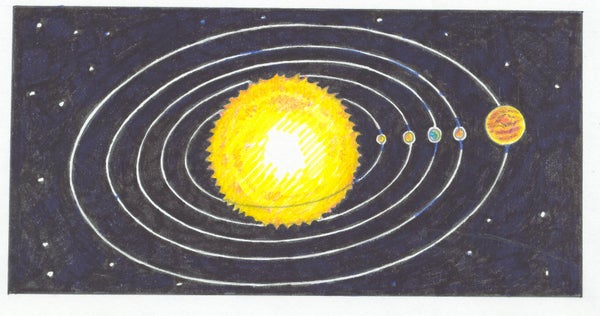

The more astronomers study the heavens, the more they realize: our solar system is weird.
"There are a few things that make the solar system kind of strange." Lauren Weiss, an astrophysicist at the University of Montreal. "One of which is we have a giant planet. Only about 10 percent of sunlike stars have a giant planet. And there are probably even fewer that have two giant planets."
In addition to giant Jupiter and lesser giant Saturn, we have tiny Mercury—just a bit bigger than Earth’s moon.
On supporting science journalism
If you're enjoying this article, consider supporting our award-winning journalism by subscribing. By purchasing a subscription you are helping to ensure the future of impactful stories about the discoveries and ideas shaping our world today.
So if we’re weird, what does a typical solar system look like? Weiss and her team trained their telescopes on 355 star systems known to host a handful of small exoplanets. And they found that most of the planets within individual star systems tended to be similar in size.
"So if I'm a planet, and I'm, say, two times the size of Earth, my neighbor, the next planet over, is also likely to be two times the size of Earth, give or take a little bit."
And they were strung out at similar distances from each other too…like peas in a pod, she says. Compared to that orderly array, our system looks more like, "Uh let's see, if I stick with food…I don't know…like a whole Thanksgiving dinner or something?"
The results are in The Astronomical Journal. [Lauren M. Weiss et al., The California-Kepler Survey. V. Peas in a Pod: Planets in a Kepler Multi-planet System Are Similar in Size and Regularly Spaced]
As for hunting for habitable worlds: "If we're trying to find an Earth-sized planet in the habitable zone”—not too close to the star but not too far away either—“and we find an Earth-sized planet closer in, it might be worthwhile to continue searching for planets around that star."
Because there might just be a few more peas in the pod.
—Christopher Intagliata
[The above text is a transcript of this podcast.]
