
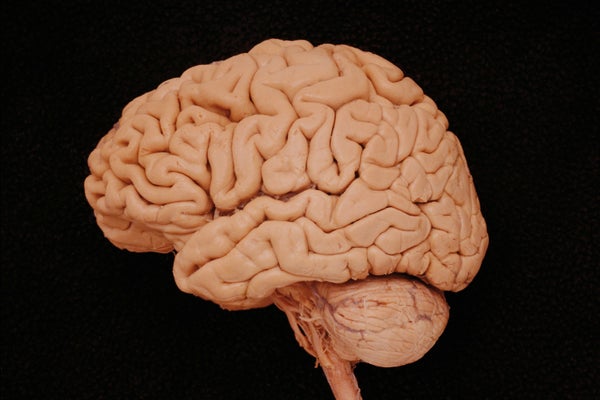

Back in ancient times, philosophers like Aristotle were already speculating about the origins of taste, and how the tongue sensed elemental tastes like sweet, bitter, salty and sour. "What we discovered just a few years ago is that there are regions of the brain—regions of the cortex—where particular fields of neurons represent these different tastes again, so there's a sweet field, a bitter field, a salty field, etcetera." Nick Ryba [pron. Reba], a sensory neuroscientist at the National Institutes of Health.
Ryba and his colleagues found that you can actually taste without a tongue at all, simply by stimulating the "taste" part of the brain—the insular cortex. They ran the experiment in mice with a special sort of brain implant—a fiber-optic cable that turns neurons on with a pulse of laser light. And by switching on the "bitter" sensing part of the brain, they were able to make mice pucker up, as if they were tasting something bitter—even though absolutely nothing bitter was touching the tongues of the mice.
In another experiment, the researchers fed the mice a bitter flavoring on their tongues—but then made it more palatable by switching on the "sweet" zone of the brain. "What we were doing here was adding the sweetness, but only adding it in the brain, not in what we were giving to the mouse." Think adding sugar to your coffee—but doing it only in your mind. The findings appear in the journal Nature. [Yueqing Peng et al, Sweet and bitter taste in the brain of awake behaving animals]
On supporting science journalism
If you're enjoying this article, consider supporting our award-winning journalism by subscribing. By purchasing a subscription you are helping to ensure the future of impactful stories about the discoveries and ideas shaping our world today.
Ryba says the study suggests that a lot of our basic judgments about taste—sweet means good, bitter means bad—are actually hard-wired at the level of the brain. As for that virtual-sugar-in-your-coffee idea? "I think it's basically science fiction to think that this would be something that would be applied to humans." But today’s science fiction might be tomorrow’s artificial sweetener.
—Christopher Intagliata
[The above text is a transcript of this podcast.]
[Scientific American is part of Nature Publishing Group.]
