
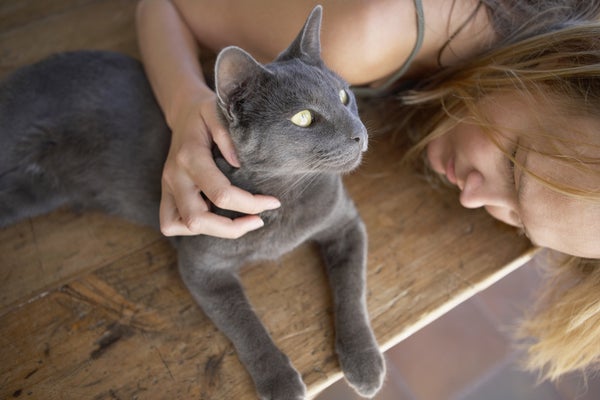

We tend to see house cats as aloof and independent, mostly preferring to engage in their own kitty business. But that assumption may be littered with error. Because a new study finds that, given a choice, Fluffy would probably pick you over her favorite toy or treat. The research—which might give cat owners pause—apurrs in the journal Behavioral Processes. [Kristyn R. Vitale Shreve, Lindsay R. Mehrkam and Monique A. R. Udell, Social interaction, food, scent or toys? A formal assessment of domestic pet and shelter cat (Felis silvestris catus) preferences]
Scientists have analyzed what dogs like. And cotton-top tamarins, Galapagos tortoises, even giant pandas. But Kristyn Vitale Shreve, a grad student at Oregon State University, realized that no one had ever really put feline predilections to the test.
So Shreve and her team got 25 house cats and 25 shelter cats and stuck each in a room with a set of several items. In the first round of tests, kitties got to spend time with objects in four different categories: toys, like a feather or a stuffed mouse; odors, like a cloth that smells of catnip or a gerbil; food, like tuna or chicken; and a human, who would pet them or talk to them or play with them.
On supporting science journalism
If you're enjoying this article, consider supporting our award-winning journalism by subscribing. By purchasing a subscription you are helping to ensure the future of impactful stories about the discoveries and ideas shaping our world today.
In the final round, the top item from each category would be pitted head-to-head-to-head-to-head for the title of kitty’s most favorite thing.
The results? “Our take home message is that although each cat displays an individual preference for each item,” Kristyn Vitale Shreve, “the majority of cats and shelter cats preferred interaction with a human. Followed next by food, then toys, then scent.”
Fully half the cats preferred spending time with people—although tuna did come in a close second. And six of the 50 test kitties chose to keep it finicky by refusing to interact with anything or anyone at all.
The results suggest that if you ever want to purrsuade your feline friend, you might offer your attention as a reward.
“This research is relevant, especially in an applied setting, where preference tests like these could be used to assess an individual’s most preferred item. And then that item could be used for training purposes. Or even to serve as enrichment, especially for shelter cats or potentially other captive wild cats to reduce negative behaviors or even stereotypic behaviors.”
—Karen Hopkin
[The above text is a transcript of this podcast.]
