Magnitude 3.0 Earthquake Rumbles New York City Less Than 2 Years after the Last Temblor

The magnitude 3.0 earthquake that shook the East Coast came nearly a year and a half after a magnitude 4.8 quake shocked New York City and its surroundings

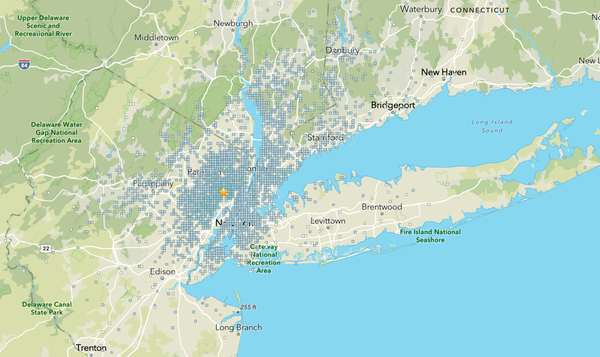
This USGS map shows the epicenter of the August 2, 2025 earthquake as well as where the shaking was felt in New Jersey and New York.

A magnitude earthquake 3.0, with an epicenter near Hasbrouck Heights, N.J., was felt throughout parts of New Jersey and New York State on August 2, 2025, according to the U.S. Geological Survey.

USGS

Join Our Community of Science Lovers!

New York City and the broader East Coast were shaken by a magnitude 3.0 earthquake late on August 2, reminding locals of a significantly larger quake that startled the region in April 2024.

The new earthquake, which occurred at 10:18 P.M. EDT, was centered near Hasbrouck Heights, N.J., about 10 miles from downtown Manhattan, at a depth of about six miles, according to the U.S. Geological Survey. Neither New York City nor Bergen County, New Jersey, where Hasbrouck Heights is located, reported major damage or injuries, according to the New York Times.

Earthquakes large enough to be felt are uncommon in the eastern U.S. “It’s a pretty quiet part of the country,” said Benjamin Fernando, a seismologist at Johns Hopkins University, in an interview with Scientific American in 2024.


On supporting science journalism

If you're enjoying this article, consider supporting our award-winning journalism by subscribing. By purchasing a subscription you are helping to ensure the future of impactful stories about the discoveries and ideas shaping our world today.


READ MORE: How Likely Is a Major Earthquake in New York City—And Is the City Prepared for It?

But small earthquakes, with magnitudes of 2.5 or lower, are quite common in the region. The earthquake magnitude scale is logarithmic, with each whole-number increase in magnitude representing a 10-fold increase in the size of the seismic waves it produces. That means the 2024 earthquake was 63 times bigger than the August 2 event. (The massive earthquake that rattled Russia just days ago, a magnitude 8.8 event, produced seismic waves that were a stunning 630,000 times larger in amplitude than the August 2 New Jersey quake.)

A set of concentric circles cropped within a rectangular frame are scaled to show the amplitude of earthquakes measuring 4.0, 5.0, 6.0, 7.0, 8.0 and 9.0 on the Richter scale. Each whole number increase corresponds to a 10-fold increase in amplitude. A second set of concentric circles cropped within a rectangular frame are scaled to show the energy released by earthquakes measuring 4.0, 5.0, 6.0 and 7.0 on the Richter scale. Each whole number increase corresponds to a 32-fold increase in energy.

Amanda Montañez

In turn, the August 2 event created seismic waves with about three times the amplitude of a magnitude 2.5 event, which represents the high end of typical activity in the region.

The August 2 earthquake occurred nearly 40 miles away from the 2024 earthquake. That is too far away for the new event to be considered an aftershock of the previous one, although the 2024 quake does continue to spur aftershocks, according to the USGS.

The USGS attributed the August 2 earthquake to “faulting at shallow depths in the crust” and noted that it did not occur near a plate boundary. The region has many faults, but these fractures in Earth’s crust are very old—they date to the era when the Appalachian and Blue Ridge Mountains were built, which occurred hundreds of millions of years ago.

Although the East Coast is not prone to large earthquakes like the West Coast is, the rattling of an East Coast quake is felt more broadly because the hard bedrock of the region transfers seismic energy more efficiently than the heavily faulted West Coast bedrock.

If you felt the quake, share your observations with the USGS.

Meghan Bartels is a science journalist based in New York City. She joined Scientific American in 2023 and is now a senior reporter there. Previously, she spent more than four years as a writer and editor at Space.com, as well as nearly a year as a science reporter at Newsweek, where she focused on space and Earth science. Her writing has also appeared in Audubon, Nautilus, Astronomy and Smithsonian, among other publications. She attended Georgetown University and earned a master’s degree in journalism at New York University’s Science, Health and Environmental Reporting Program.

More by Meghan Bartels

It’s Time to Stand Up for Science

If you enjoyed this article, I’d like to ask for your support. Scientific American has served as an advocate for science and industry for 180 years, and right now may be the most critical moment in that two-century history.

I’ve been a Scientific American subscriber since I was 12 years old, and it helped shape the way I look at the world. SciAm always educates and delights me, and inspires a sense of awe for our vast, beautiful universe. I hope it does that for you, too.

If you subscribe to Scientific American, you help ensure that our coverage is centered on meaningful research and discovery; that we have the resources to report on the decisions that threaten labs across the U.S.; and that we support both budding and working scientists at a time when the value of science itself too often goes unrecognized.

In return, you get essential news, captivating podcasts, brilliant infographics, can't-miss newsletters, must-watch videos, challenging games, and the science world's best writing and reporting. You can even gift someone a subscription.

There has never been a more important time for us to stand up and show why science matters. I hope you’ll support us in that mission.

Thank you,

David M. Ewalt, Editor in Chief, Scientific American

Subscribe