
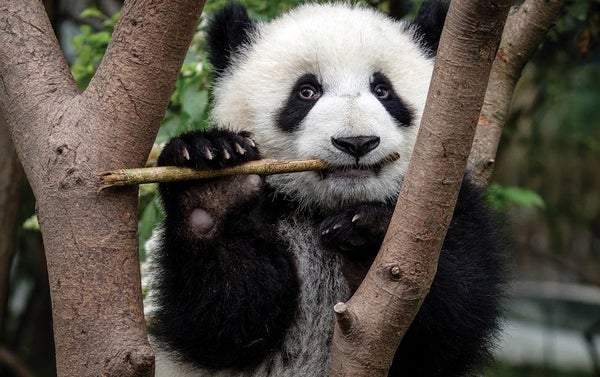
A bear that roamed what is now China about six million years ago is the oldest bamboo-eating panda ancestor yet found—and it had the same stubby pseudo thumbs that jut from the wrists of today's pandas alongside their five fingers. Fossils of the new species suggest such “thumbs,” which helped the animals grip and strip bamboo, maintained their peculiar shape to facilitate the beast's four-legged locomotion.
The fossils, found in the province of Yunnan and described in Scientific Reports, also push back the date that pandas' ancestors likely transitioned from eating meat to chomping bamboo—from two million to six million years ago. “Giving up on a carnivorous diet means trading the volatile life of a carnivore for quiet consumption of the plentiful bamboo,” says paleontologist and study lead author Xiaoming Wang of the Natural History Museum of Los Angeles, adding that it was “not a bad deal.”
Although the fossils dug from the province's Zhaotong Basin included only teeth and some limb bones from the bear, these were distinctive enough for Wang and his colleagues to identify the fossils as belonging to an early member of the panda lineage called Ailurarctos. A wrist bone in the collection, with its proto-thumb, stands out among the remains. “Its morphology is really close to that of the living panda,” says Juan Abella Pérez of Miquel Crusafont Catalan Institute of Paleontology in Barcelona, who was not involved in the new study.
On supporting science journalism
If you're enjoying this article, consider supporting our award-winning journalism by subscribing. By purchasing a subscription you are helping to ensure the future of impactful stories about the discoveries and ideas shaping our world today.
Why didn't this nubby outcropping eventually evolve into a longer, larger false thumb to better grasp a meal? The researchers propose that treading on all fours was the key constraint: If the panda's thumb were larger, Wang and his colleagues suggest, the appendage could have interfered with walking or faced a high risk of breaking. There was no way for pandas' false thumbs to evolve to be larger or more complex without the bears becoming bipedal or otherwise getting the appendage out of the way. In a sense, this makes the evolution of the panda's thumb all the more impressive. The distinctive structure was constrained by the need to move as well as to eat, an evolutionary compromise rather than an ideal structure for grabbing long sticks of bamboo.