
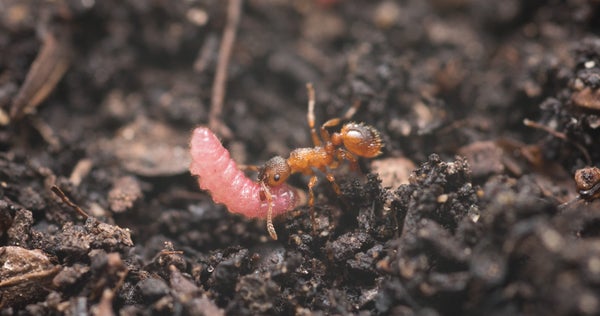
Certain crafty caterpillars have an unusual approach to ensuring they live long enough to become a butterfly: each convinces an ant to carry it into the ant’s nest, providing food and shelter. Now scientists have found that these caterpillars use a surprisingly complex rhythm like a secret knock to convince the ants to come fetch them.
That’s according to research published on February 25 in Annals of the New York Academy of Sciences, which found that caterpillars can keep a beat called double meter that has so far been identified only in a couple of primates, says co-author Chiara De Gregorio, who studies animal behavior at the University of Warwick in England. “That was very exciting,” she says.
De Gregorio more regularly studies primates than insects, but her focus is on how rhythm shapes communication. She expanded to insects when colleagues approached her and noted that these caterpillars were somehow internally generating vibrations that seemed to mimic the pitch of a queen ant. (The ants rub together hardened parts of their abdomen to make their vibrations, but scientists aren’t sure yet how the caterpillars are accomplishing the feat.) The scientists wondered whether the caterpillars might have been matching the ants’ rhythm as well.
On supporting science journalism
If you're enjoying this article, consider supporting our award-winning journalism by subscribing. By purchasing a subscription you are helping to ensure the future of impactful stories about the discoveries and ideas shaping our world today.
So the researchers headed out to the field in northern Italy and collected nests from two groups of ants, as well as caterpillars from nine species of butterflies that were related to one another but that had shown varying degrees of association with ants—some absolutely required tending by ants to survive, others were happy to be taken in could can manage on their own, and the rest had no connection with ants at all.
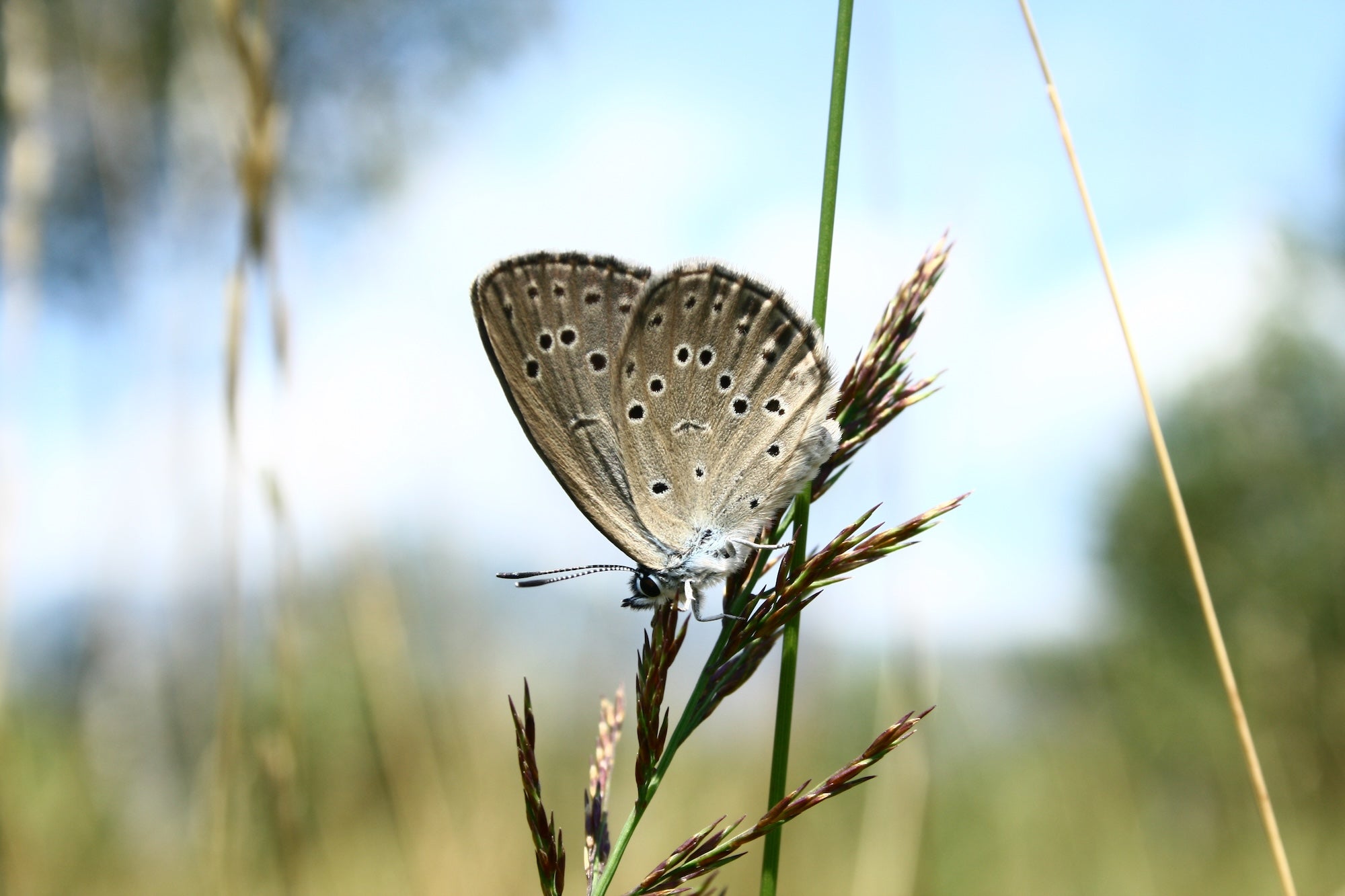
One of the Maculinea butterflies as an adult.
Vibrant Lab, Torino (CC BY-SA)
The scientists then recorded the vibrations each animal made. Amplified to reach a human ear, they just sounded like noise, but with the help of acoustic analysis software, De Gregorio and her colleagues were able to parse the rhythms created by each insect.
All the insects that the researchers analyzed were able to keep a steady pulsing beat that scientists call isochrony. “We were already shocked when we found really regular metronomic isochronous signal,” De Gregorio says. “We were like, ‘Oh, that’s very cool.’”
But what was even more surprising was that both the ants and the caterpillars who required care from them also created a much rarer rhythm called double meter, in which one beat lasts either twice or half as long as the beat that follows it. So far, De Gregorio says, scientists have yet to observe double meter in birds and have only found it in the vocalizations of a couple species of primate.
She and her colleagues hope to follow up with more experiments on these insects, particularly manipulating caterpillar recordings to understand how ants’ tendency to rescue caterpillars varies with the summons.
Overall, De Gregorio hopes the finding underscores the role of rhythm in communication. “The more we study rhythm, the more we see [it] in so many different animal species,” she says. “Evolution works in very weird and funny ways.”