
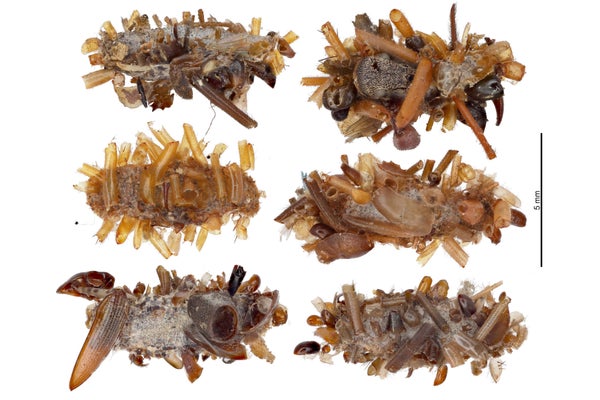
Caterpillars are known for their fuzzy exterior and sometimes weird behavior. Some vibrate aggressively to scare predators; others create their own antifreeze to survive the cold. But a newly identified member of the offbeat caterpillar club might be the weirdest of all. Nicknamed the “bone collector,” it builds a disguise from insect cadavers it scrounges from a spiderweb, covering its body with these spider-meal leftovers—and occasionally engaging in cannibalism.
It took researchers almost 17 years to convince themselves that this behavior was not some kind of anomaly among a couple of individuals. After meticulous observations and fieldwork, they finally confirmed that bone collector caterpillars, with all their macabre eccentricity, are the larvae of a new species that is native to the Hawaiian island of Oahu. The finding was published on Thursday in Science.
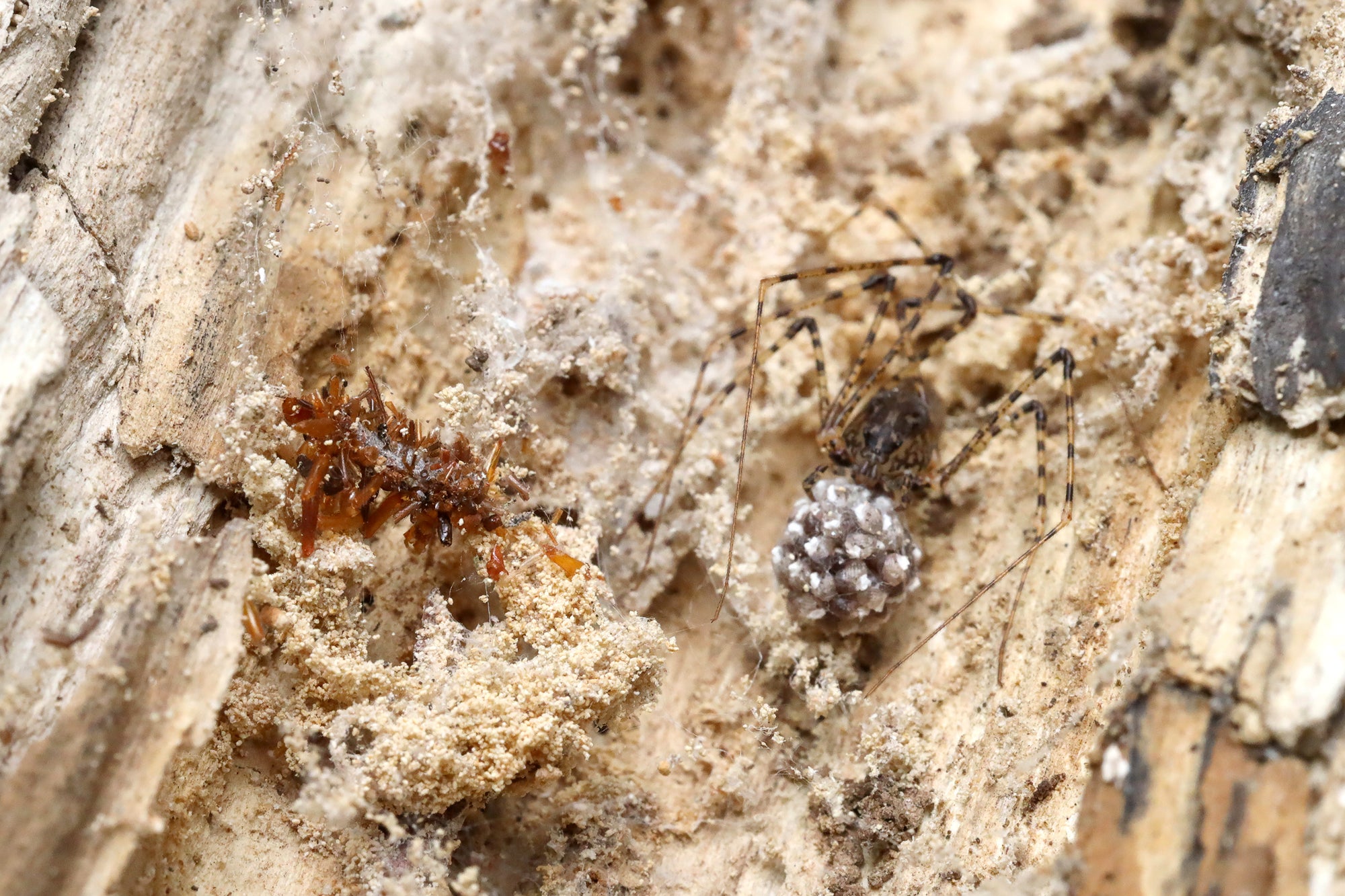
Bone collector larva in web.
Rubinoff Lab, Entomology Section, University of Hawaii at Manoa
On supporting science journalism
If you're enjoying this article, consider supporting our award-winning journalism by subscribing. By purchasing a subscription you are helping to ensure the future of impactful stories about the discoveries and ideas shaping our world today.
“I just couldn’t believe it. The first couple of times you find that, you think it’s got to be a one-off—it’s got to be a mistake,” says the study’s lead author Daniel Rubinoff, an entomologist at the University of Hawaii at Manoa. “I’ve been looking at it for over a decade, and it still blows my mind.”
So how exactly did these caterpillars take on this hardcore habit? The answer is probably evolutionary, Rubinoff says. Bone collector caterpillars grow up to be moths, like most caterpillars do, but these moths tend to lay their eggs in a spiderweb’s nooks and crannies. A newly hatched caterpillar then collects bones to “camouflage itself from the spider landlord,” Rubinoff says. “The only chance they have of making a living in this situation is to decorate or die; they live for fashion.”

Adult “bone collector” moths lay their eggs in spiderwebs.
Rubinoff Lab, Entomology Section, University of Hawaii at Manoa
Setting aside the threat of becoming spider food, for a bone collector caterpillar, a web is actually a great place to snack on the arachnid’s leftovers, such as a beetle’s wings or a fly’s soft tissue. The web is thus an “unexploited niche” of food and protection from other predators, Rubinoff says. Harder bits get added to its protective casing.
These bone collectors are not quite parasitic, nor are they considered symbiotic with spiders. They’re more like a scavenger in the way they pick from meals that a spider might have otherwise finished. Plus, Rubinoff notes, they’re cannibalistic. “That just gives you a sense of how they go after food—and recognize that there’s food inside things that maybe don’t look like food,” he says.
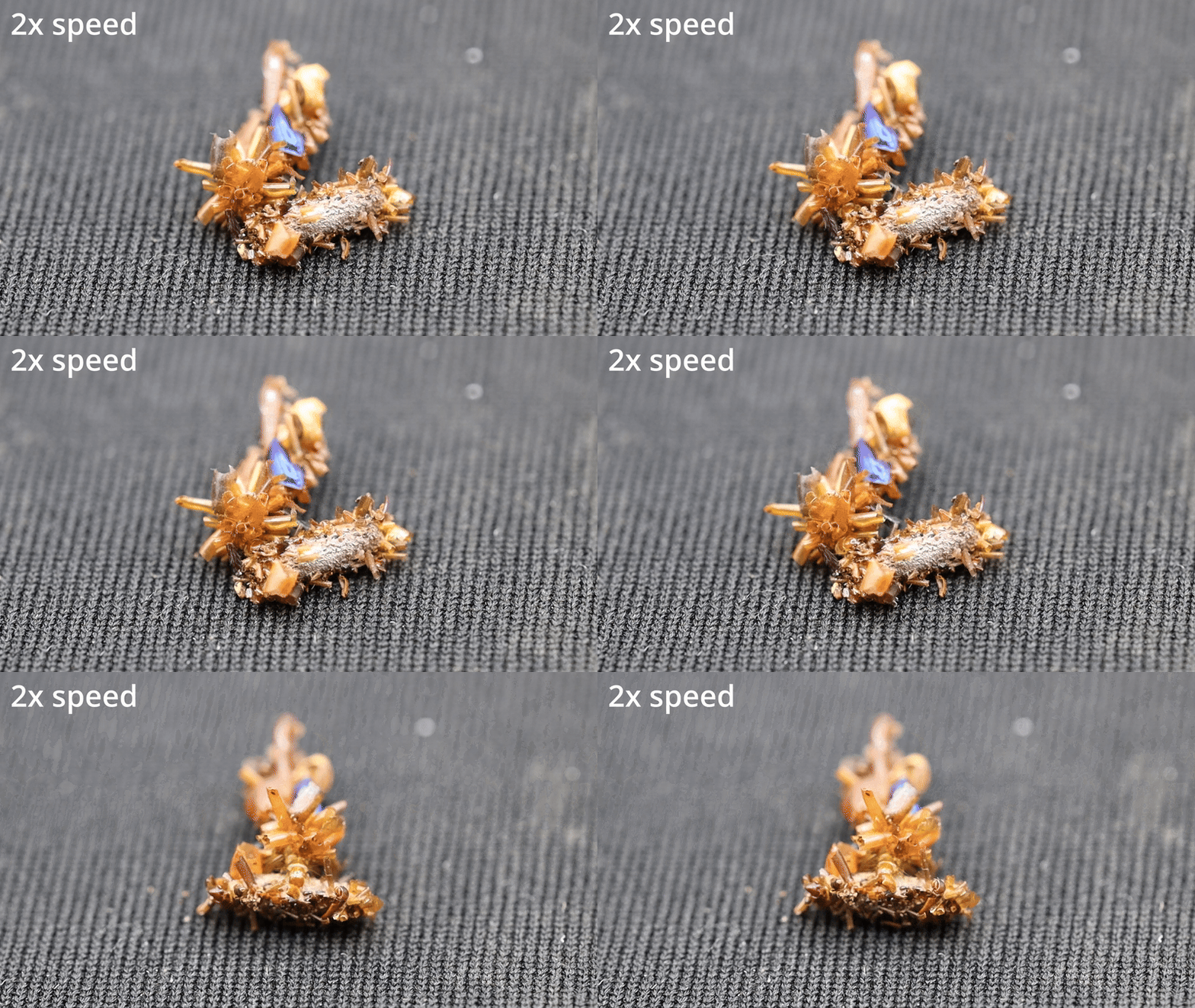
Video of a Hawaiian “bone collector” caterpillar, camouflaged in its insect prey’s body parts, crawling on black fabric at 2X speed.
Rubinoff Lab, Entomology Section, University of Hawaii at Manoa
And these critters are far from the only strange, funky caterpillars roaming Hawaii. The bone collector belongs to a native genus of moths called Hyposmocoma, whose larvae are commonly referred to as Hawaiian fancy case caterpillars. They have lived in these islands for millions of years, says Akito Kawahara, who is director of the McGuire Center for Lepidoptera and Biodiversity at the Florida Museum and was not involved in the new work. “They’ve adapted to the environment because the conditions of Hawaii are very different from other places around the world,” he explains.
Some of these adaptations have resulted in “bizarre morphology and life history,” says Cornell University entomologist Patrick M. O’Grady, who was also not involved in the study. Several Hyposmocoma species are known to be carnivorous. Others are aquatic and live under Hawaii’s streams.
“Insects do everything,” Kawahara adds. “They’re amazing. In some ways, I was not surprised [by the bone collectors] because I know insects do some really crazy things.”
For Rubinoff, who has studied insects for more than two decades, species like the bone collector are a constant reminder of “how little we know about insect diversity—even in places [where] we should know it pretty well” such as Hawaii, which is comparatively easy to access. “We’re finding stuff that we didn’t even imagine was out there,” he adds. “It wasn’t something that was even on our radar. But it shows how interesting evolution can be. It really is—I don’t want to say magic—but it’s incredible.”