

Jeff DelViscio: Hi, Science, Quickly listeners. This is Jeff DelViscio, executive producer of the show.
The whole podcast team is out in the field, so while we’re away, we’re bringing back a few amazing oldies from the archive.
On supporting science journalism
If you're enjoying this article, consider supporting our award-winning journalism by subscribing. By purchasing a subscription you are helping to ensure the future of impactful stories about the discoveries and ideas shaping our world today.
Fall in the Northern Hemisphere is just a week away. Soon the temperatures will cool (hopefully!), and the animals who hibernate will start to hoard food and make their dens in preparation for winter.
You know the woolly bear caterpillar, right? It’s technically the Isabella tiger moth, but I digress. Most of us probably know them as furry little seasonal forecasters. (They don’t really forecast anything; that’s just superstition.) Well, the woolly bear has a different strategy when it comes not freezing to death during winter.
Producer Kate Furby gets low, inches from the ground, to learn their secrets. You’ll have to listen on to learn how they do it.
The episode was first aired on March 3, 2023.
Enjoy!
Kate Furby: Some caterpillars have evolved with antifreeze in their body cavities, allowing them to become cater-Popsicles to survive cold winters. But climate change could threaten that.
Martha Weiss: So there are caterpillars that have been reported to be put into an ice cube and frozen, and then when the ice cube melts, they can get up and walk away.
[CLIP: Music]
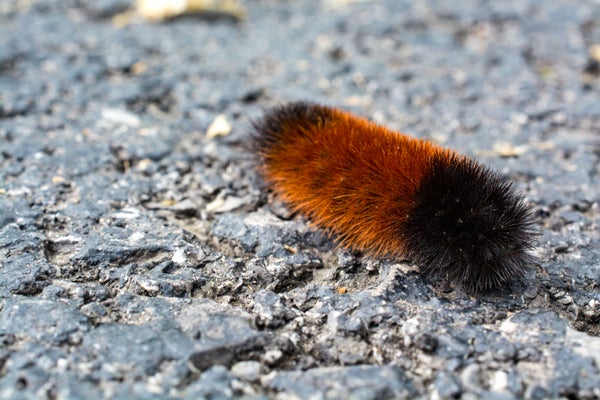
Furby: You may have seen them scooting around on leaf litter in the fall. They’re furry, rotund and famous for their rumored weather forecasting skills. I’m talking about the woolly bear caterpillar, or Isabella tiger moth.
These little creatures have an orange waistband stripe, whose width is rumored to predict how long winter might be. And while this is based in colonial folklore, not science, what is scientifically amazing is how the woolly bear caterpillar is able to survive winter.
[CLIP: Music]
I’m Kate Furby, and you’re listening to Science, Quickly.
[CLIP: Music]
Furby: Unlike humans and other mammals, caterpillars can’t regulate their body temperatures. And unless they burrow or cocoon, they’re subject to the wind and rain. The woolly bear caterpillar, like its name, is covered in a spiky looking fuzz.
Weiss: Those hairs you might think of as a little down jacket for the caterpillar to wear, and I’m sure that they do provide a little bit of insulation.
Furby: That’s Dr. Martha Weiss, a biologist and professor at Georgetown University, who studies plant-insect interactions. She says that spiky little caterpillar jacket has a specific use but not what you might think.
Weiss: Those hairs are thought to have evolved as a way to protect the caterpillars against predators and maybe against parasitoids that wanna lay their eggs inside the caterpillar’s body.
Furby: Yikes, that is a superpowered little jacket actually. But here’s the caterpillar’s dilemma.
Weiss: Well, the main thing is that it gets really cold, and they have a lot of water in them, and they can freeze. And so they need to be able to deal with freezing temperatures.
Furby: And while the famous furry jacket provides protection, it doesn’t provide the kind of insulation woolly bear caterpillars need for a hard Chicago winter. What they do is a little more biochemical.
Weiss: They have more biochemical tricks up their sleeves insofar as caterpillars could be said to have sleeves.
Furby: Oh wow, they would have to have like 16 little sleeves! But okay, so what are their options for survival?
Weiss: They can also do biochemical things and physiological things to make it less likely that they will turn into an ice cube. So what some of those caterpillars do is: they use antifreeze. They basically make compounds like glycerol that they put into their cells.
Furby: In case you’re not familiar with glycerol, it’s a natural alcohol compound. It works similarly to when we salt city sidewalks to keep them from becoming icy. The compounds in the woolly caterpillar’s body lower its freezing point, buying it some time. And then they do something even more remarkable.
Weiss: They move water out of their cells so that it freezes in the extracellular space.
Furby: That’s because ...
Weiss: Water of course gets bigger when it turns to ice. And so if a cell was filled with water, and it froze, then it could bust the cell membrane, and that would really harm the caterpillar. So getting the water out of the cell is a good idea, and lowering the temperature at which the liquid freezes is also a good idea.
Furby: So these little guys can freeze solid all winter and then thaw out and get up and walk away come spring.
Weiss: They can actually freeze and thaw multiple times over the course of a winter.
Furby: But there’s an energetic cost that comes to falling asleep and waking back up again.
Weiss: Studies of the Isabella tiger moth have shown that they can in fact undergo several freeze thaw cycles, but it’s really not great for them. It’s better if they can freeze, stay frozen and then thaw at the end of the winter.
Furby: And not only that ...
Weiss: I think there’s also some damage that happens to some of the structures in the caterpillar. Some of the more delicate parts, I think, can be damaged a little bit. And the more times they have to freeze, thaw and refreeze, the more likelihood that they'll be a little worse for wear at the end of the winter.
Furby: And this gets worse because of things like climate change.
Weiss: If we have winter heat waves or warm periods when caterpillars that had been in the deep freeze, thaw out and then freeze again, there was some concern that they wouldn’t be able to go back and forth between these conditions.
Furby: That’ll also lead to larger ecological implications.
Weiss: Caterpillar populations and therefore butterfly or moth populations could take a hit if the overwintering survival is interfered with by these interludes of warmer weather that prevent them from getting through their wintering period in the same way that they had before.
Furby: And that might have more profound impacts than we think. We already know that some important pollinators, like bees and butterflies, are struggling to survive due to all kinds of human activities.
Weiss: Caterpillars are important just because they’re such cool animals, but they also are a phase of the life cycle of lepidopteran, so moths and butterflies. They are pollinators; they’re herbivores; they're food for birds and other organisms. And they’re just part of what makes the world fun to look at and live in.
For Scientific American’s Science, Quickly, I’m Kate Furby.
[Image credit: Wirestock/Getty Images]
