
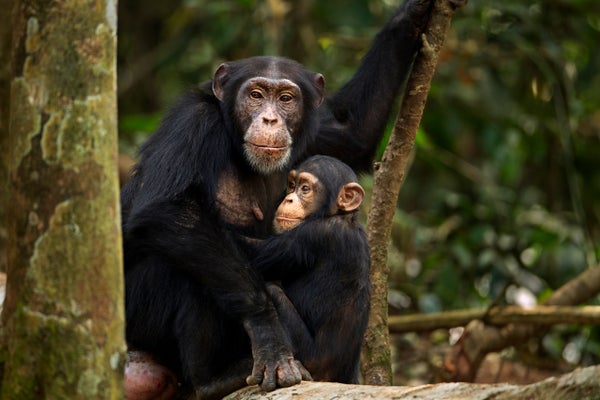
Rubin, a baby bonobo, was foraging near his mother Rose in the Congo rain forest when an adult bonobo named Olive snatched some food from Rubin’s tiny hands. Then Olive smacked the baby, hard, in the face and neck—right in front of his mother.
Primatologist Rachna Reddy of the University of Utah, who was observing the group from about 30 feet away, expected Mom to lay down the law. “I was just like, ‘Gasp! Somebody’s about to get beaten up,’” she says. But to Reddy’s shock, Rose didn’t lift a finger, even as baby Rubin wailed.
In a recent study, Reddy and her colleagues documented some surprising differences in the parenting philosophies of humanity’s two closest cousins: bonobos and chimpanzees. While bonobo mothers very rarely stepped in when someone was “mean” to their children, chimpanzees behaved more like “helicopter moms,” intervening nearly half the time. This ran counter to primatologists’ expectations of these two species and shows that “what it means to be a supportive parent varies across the animal kingdom,” Reddy says. The study was published in February in Animal Behaviour.
On supporting science journalism
If you're enjoying this article, consider supporting our award-winning journalism by subscribing. By purchasing a subscription you are helping to ensure the future of impactful stories about the discoveries and ideas shaping our world today.
Bonobos and chimpanzees have vastly different reputations. Bonobos are often seen “as being the nicer of our cousins,” while chimps get a bad rap, explains Elizabeth Lonsdorf, a primatologist at Emory University, who wasn’t involved in the new paper. In chimpanzee society, dominant males use lethal force to defend their turf, and infanticide and sexual coercion against females are common. Bonobo society is matriarchal, and females have a lasting impact on their offspring. This is especially the case for sons, who inherit their rank from their mother and may need her help as a “wingwoman” to mate successfully.
Frankly, Reddy says, she had expected dominant female bonobos to be “supermoms.” But after watching Olive smack Rubin with impunity, Reddy set out to see if she’d stumbled on a species-level difference in parenting styles.
During multiple field seasons, Reddy and her team followed chimps in Kibale National Park in Uganda and bonobos in Kokolopori Bonobo Reserve in the Democratic Republic of the Congo. The researchers documented what happened every time another member of the species was “mean” to a youngster in the presence of their mother—by, say, biting them, pushing them out of a tree or stealing a choice piece of food. Surprisingly, bonobo moms took a more hands-off approach; they got involved in just 8 percent of conflicts where their child was the “victim.” Chimp mothers intervened nearly half the time.
Given the species’ reputations, it’s tempting to assume that chimpanzee moms step in because their offspring are in genuine danger—and bonobo moms lean back because they know their kids won’t face serious harm in their gentler society. But according to Reddy’s data, bonobo and chimp youngsters both face conflicts with similar risks of real harm. Indeed, Reddy saw some young bonobos get hurt or miss out on food while their mother watched.
So why would the female bonobos be holding back? At first, Reddy and her team thought it might be to preserve politically important relationships with other dominant females. But bonobo mothers were equally unlikely to intervene even when the aggressor was an orphaned male—one of the lowest-ranking members of a bonobo social group.
Reddy was also surprised to find a difference in how bystanders reacted when youngsters got into trouble. Chimpanzees who weren’t the victim’s mother intervened in 21 percent of the conflicts. Bonobo bystanders stepped in 7 percent of the time. The researchers say this could suggest a deeper psychological difference between bonobos and chimpanzees, one that goes well beyond parenting.
While more research is needed to determine if these patterns hold in other populations of these primates, one possible explanation is that the constant threat of violence in chimpanzee life could prime chimps to defend other members of their social group, regardless of the situation. In-group bonds are “a really core part” of chimp society, Reddy explains. Chimpanzees “can take big risks to protect each other in encounters [with a hostile group]—like leaping over to cover someone who’s being attacked” with their own body, Reddy says.
Lonsdorf says the new study is impressive work with exciting results. “It’s counter to our initial gut response as primatologists and to the popular perceptions of these guys,” she says. In this case, chimps’ famous reactivity actually “means they intervene more.”
And importantly, chimpanzee moms don’t necessarily always launch a counter-attack when butting in to defend their offspring, Reddy says; the situation may provoke aggression, but it “also might mean going and embracing the aggressor.”
“A society that has these higher levels of aggressiveness might be more protective, might be more amicable [and] might be more empathetic at certain levels as well,” says study co-author Martin Surbeck of Harvard University, who studies the social behavior of primates.
At the same time, experts agree that it’s important not to “mom shame” bonobos by imposing our human-centric ideas of what a supportive parent looks like. “It’s not that [bonobos] are bad mothers,” Surbeck says. Conflict intervention may just “not be so much an aspect of their mothering as it is in chimpanzees.”