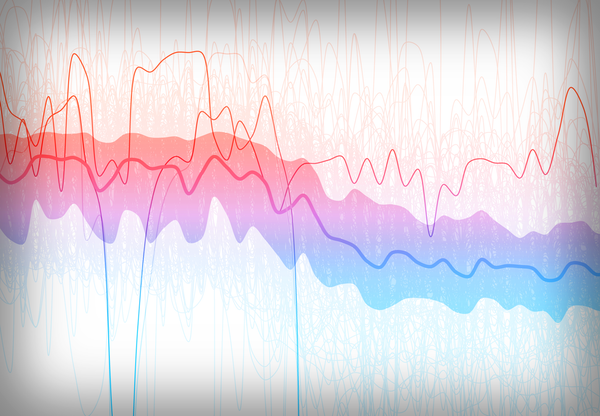
Earthquakes send strong tremors through the earth's crust, recorded by seismometers planetwide. Human bustle also creates an ongoing, high-frequency vibration—a background buzz—in the rock. After cities, states and countries implemented lockdowns to try to slow the spread of COVID-19 this past spring, the volume of human ground noise fell by up to 50 percent on average in various regions, as people stayed home instead of taking cars, buses and trains to work and school and as businesses and industries curtailed operations. The decline, evident for months, was recorded by seismometers as deep as 400 meters underground. “We were surprised,” says seismologist Stephen Hicks of Imperial College London, “that noise from daily human activity penetrated that far down.”
Credit: Shirley Wu; Source: “Global Quieting of High-Frequency Seismic Noise due to COVID-19 Pandemic Lockdown Measures,” by Thomas Lecocq el al., in Science, Vol. 369; September 11, 2020
Subscribe to Support Independent Journalism
Great science journalism requires human expertise, time, effort and creativity. And it costs money. That’s why I and the journalists here at Scientific American hope you’ll join our community.
When you subscribe, you are supporting staff and freelance journalists who are passionate about telling science stories that are true, important and compelling. Our editors and reporters are often experts in their fields, which means they understand the nuances of big discoveries and can untangle the breakthroughs from the hype. With a subscription, you are also supporting rigorous fact-checking to ensure the words we publish are precise and accurate. And you’re supporting original illustrations, graphics and photos that bring you closer to an advanced laboratory, an ice sheet in Antarctica or a space mission in orbit. You’re helping us craft other types of high-quality journalism as well: Our newsletters are carefully written, edited and curated by staffers you have or will come to know and love. Our Science Quickly podcast is based on original reporting, collaboration with editors and scientists and exacting production.
Subscriptions keep this engine running so we can continue to deliver thoughtful, rigorous and independent science journalism to you. In an era of viral misinformation, this work is crucial. If you value what we do, I hope you’ll consider joining us as a subscriber
Thank you,
Jeanna Bryner, Editor in Chief, Scientific American